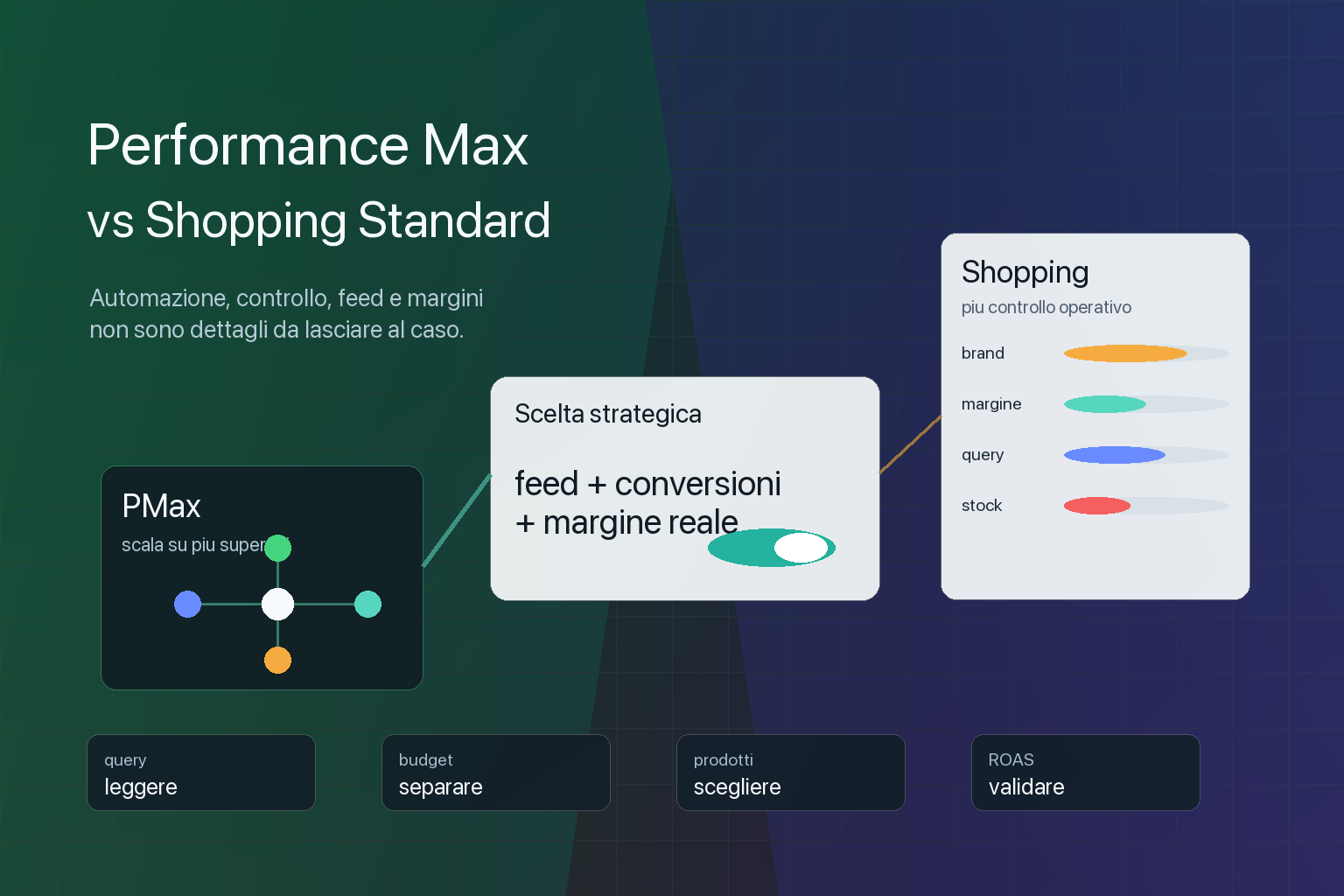
Performance Max can work very well for an eCommerce site. The problem starts when it becomes the automatic answer to everything: the whole catalogue, the whole budget, a dirty feed, weak conversions and zero control.
Plenty of Google Ads accounts have ended up like this: a single PMax campaign with every product inside it, a target ROAS set by gut feeling, generic assets, a barely segmented feed, brand and non-brand mixed together, high-margin and low-margin products in the same campaign. Then the owner looks at the report, sees an apparently good ROAS, and has no idea which products are selling, which queries are bringing value and how much budget is going to easy traffic.
Standard Shopping, by contrast, is often treated as an old-fashioned campaign type. In reality it can still be very useful when you need more control: product by product, queries, negative keywords, separate budgets, commercial priorities, tests on categories and margins.
The choice is not ideological. The right question is not "is Performance Max better than Standard Shopping?". The right question is: at this stage of the eCommerce business, which structure gives enough data, enough control and enough margin to scale without waste?
What actually differs between PMax and Standard Shopping
Performance Max is an automated, goal-based campaign type. It can show ads across several Google surfaces, using product feeds, creative assets, audience signals and conversion data. For a retailer that means a single campaign can work across Shopping and other Google inventory, trying to maximise the result you have set.
Standard Shopping has narrower coverage, but it offers more operational control over the Shopping campaign: product group structure, bids, exclusions, queries you can read, products to push or exclude, dedicated budgets.
Put simply:
- Performance Max: more automation, more surfaces, more dependence on correct conversions, feed and signals.
- Standard Shopping: less automation, fewer surfaces, more control over products, queries and budget.
This is not a contest between modern and old. It is a choice of Ads architecture. If you have clean data, a strong feed and enough volume, PMax can scale. If you need to understand what is happening, isolate problems or protect margins, Standard Shopping can be far easier to read.
When Performance Max can be the right choice
PMax makes sense when the account has healthy foundations. Not perfect, but healthy.
In particular, it works better when:
- purchase tracking is correct;
- conversion value is not duplicated or inflated;
- the Merchant Center feed is complete and well maintained;
- products have reliable titles, images, GTINs, availability and prices;
- there are enough conversions for the algorithm to learn from;
- margins and commercial priorities have been translated into segments, custom labels or separate structures;
- creative assets are not left to chance;
- brand, categories and strategic products are not all thrown into the same container.
Performance Max is not the problem when it receives good signals. The problem is using it as a shortcut to avoid strategy, feed work, data and control.
We have already seen this in the article on Performance Max and cart conversions vs orders: if you teach Google the wrong goal, Google can become very efficient at pursuing exactly that. Carts instead of orders. Apparent revenue instead of margin. Leads instead of customers.
When Standard Shopping is still very useful
Standard Shopping remains useful when you want to understand what is happening more clearly and intervene with more precision.
It can be the right choice when:
- you have little history and want to read queries, products and signals more calmly;
- the feed still needs fixing and you want to avoid PMax amplifying the confusion;
- you have categories with very different margins;
- you need to separate loss leaders from profitable products;
- you want tighter control over brand, generic queries and informational traffic;
- you have a small budget and do not want to spread it across too many surfaces;
- you need to test a specific category before scaling it;
- you need to protect seasonal products, availability or promotions;
- you want to work out whether the problem is the feed, the price, the landing page or the campaign.
Standard Shopping is not always more profitable. But it is often more diagnostic. And when an account is confused, the diagnosis is worth more than the automation.
The query question: what are you actually buying?
One of the reasons many consultants keep using Standard Shopping is the more direct read on queries and exclusions.
In eCommerce, knowing which searches you are paying for is fundamental. Not all queries are worth the same:
- brand queries;
- precise product queries;
- category queries;
- informational queries;
- competitor queries;
- overly generic queries;
- queries with off-target intent.
If a campaign delivers a strong ROAS because it captures a lot of brand searches, that is a different result from a campaign selling on profitable generic queries. The report can look similar, but the strategic quality is completely different.
PMax has added more reporting and insights than it used to have, but it remains more opaque than a well-controlled Standard Shopping structure. So when an eCommerce business does not yet know where its sales really come from, keeping some control can be a prudent choice.
Brand: an easy ROAS can hide the problem
Brand traffic is often the most profitable: users searching for the company name, a product they already know or a brand you stock. It is normal for it to convert better.
The problem arises when a PMax campaign is judged without knowing how much of the result comes from brand and how much from new demand. If a campaign takes a lot of easy traffic, it can show a high ROAS and make everything look healthy. But it may not really be bringing in new customers or growing new categories.
That does not mean brand should always be excluded or separated. It means it has to be read. For some accounts it makes sense to protect the brand with dedicated campaigns. For others it makes sense to use exclusions, controls and tests. For others again, brand inside PMax can be acceptable, but only if the report distinguishes real incrementality from existing demand well enough.
Paying to capture someone who was already looking for you can make sense. Thinking it is all new growth is another matter.
Feed and custom labels: without segmentation you control nothing
The choice between PMax and Standard Shopping depends heavily on feed quality.
If the feed contains generic titles, wrong categories, weak images, availability that is out of sync, missing GTINs and no custom labels, both campaign types will perform badly. PMax, though, can make it harder to see where the problem is blowing up.
Custom labels are essential for separating:
- high margin from low margin;
- best sellers from slow movers;
- seasonal from year-round lines;
- promotions from full price;
- products with high and low stock;
- strategic brands from filler brands;
- new products from mature ones.
We covered this in the guide to Google Shopping custom labels and in the piece on Google Merchant Center feed errors. Without that groundwork, the question "PMax or Shopping?" is premature. First you have to sort out the fuel.
Small budget: watch out for dispersion
Performance Max can spread budget across many surfaces and opportunities. With enough budget and clean data that can be an advantage. With a small budget and a fragile account it can turn into dispersion.
An eCommerce business that spends little and has few monthly sales has to choose more carefully. If the budget is smeared across a huge catalogue, different categories and confused goals, the algorithm has little room to learn. In those cases it can make more sense to start from Standard Shopping, targeted Search or a heavily segmented PMax, rather than a single PMax trying to do everything.
Budget should not be judged only in euros per day. It has to be judged against CPC, average order value, margin, number of products, conversion rate and the time needed to gather data.
The hybrid structure: often the best choice
In many accounts the answer is not "PMax only" or "Standard Shopping only". It is a hybrid structure.
Examples:
- PMax for mature categories with stable conversions and a strong feed;
- Standard Shopping for new categories, ones you need to read or ones you need to protect;
- separate Search campaigns for brand, competitors or high-intent queries;
- dedicated campaigns for high-margin products;
- separate PMax campaigns for segments with different target ROAS;
- Standard Shopping for testing price, feed and queries before scaling.
A hybrid structure avoids two mistakes: trusting automation blindly, and micromanaging everything without enough volume. It takes more effort to design, but it often suits eCommerce businesses with real catalogues, varied margins and non-trivial commercial priorities.
How to test PMax vs Shopping without arguing with the data
If you want to know which structure works better, it is not enough to look at two different periods and say "it was better before". Seasonality, promotions, stock, prices, competitors and budget can all distort the comparison.
Better to set up an orderly test:
- the same product perimeter, or comparable segments;
- a period long enough to gather data;
- correct primary conversions;
- order value and returns monitored;
- budget consistent with the goal and the volume;
- no heavy feed changes during the test;
- separate reads on new customers, brand, margin and real sales.
Google provides experiments for measuring the impact of Performance Max against Standard Shopping campaigns in certain scenarios. Even when you use official tools, though, the test only means something if the account measures the conversions that genuinely matter.
What to ask your agency
Before you accept "we set up a Performance Max campaign because Google recommends it", ask these questions.
- Why was PMax chosen instead of Standard Shopping?
- Has the feed been segmented by margin, category, brand or priority?
- Which custom labels are we using?
- Does the campaign contain the whole catalogue or only selected products?
- Are brand and non-brand read separately?
- Are the primary conversions real purchases?
- Does conversion value account for returns, cancellations and margins?
- Which products are absorbing the most budget?
- Which categories are generating profit, not just revenue?
- Have we tested Standard Shopping on specific segments?
- Is there a plan for negative queries, products to exclude and budget to reallocate?
- Are we using experiments and clean comparisons, or just impressions?
If the answer is "Performance Max does it all by itself", the most important part is missing: the strategy.
How we handle it at BitHub
At BitHub we do not pick PMax or Standard Shopping out of habit. We start from the business, the catalogue, margins, tracking and feed quality.
The work can include:
- a Google Ads audit covering Shopping, PMax, Search campaigns and conversions;
- checking the Merchant Center feed, titles, GTINs, availability and images;
- segmentation with custom labels for margins, seasonality, brand and stock;
- separating products to scale, to test or to exclude;
- verifying conversion value against orders, returns and cancellations;
- a hybrid structure when you need control and automation together;
- PMax vs Shopping tests on sensible perimeters;
- reports that connect Ads, feed, eCommerce and real commercial results.
This ties into our work on SEO and Google Ads, bespoke eCommerce development, digital strategy and platforms whose catalogues can genuinely be governed.
The point is not to be against automation. It is to give it good ground to work on, and to keep enough control to tell when it is helping and when it is only spending in a way that looks good.
Useful sources
For the technical detail, you can start from the Google documentation on Performance Max, the Performance Max best practices for online sales goals, the guide to Standard Shopping campaigns and Performance Max experiments, including the Standard Shopping vs Performance Max comparison.
FAQ
Is Performance Max always better than Standard Shopping?
No. PMax can scale better when tracking, feed and conversions are clean. Standard Shopping can be more useful when you need control over products, queries and budget, and when you need to diagnose problems.
Does it make sense to use PMax and Standard Shopping together?
Yes, in many accounts a hybrid structure makes more sense. PMax can work on mature segments, while Standard Shopping can cover categories you want to test, strategic products or finer control.
Is Standard Shopping an outdated campaign type?
It is less automated, but not useless. For many eCommerce businesses it remains a valuable tool for reading queries, products, product groups, budget and performance with more control.
When is a single PMax across the whole catalogue risky?
When the catalogue has varied margins, seasonal products, very different brands, variable stock or unreliable conversions. In those cases a single campaign can hide problems and move budget onto products that are not a priority.
Does the feed matter more than the campaign choice?
Often yes. A weak feed damages both Standard Shopping and Performance Max. Titles, images, availability, GTINs, categories and custom labels are the foundation to fix before debating the Ads structure.
How do I tell whether PMax is bringing real growth?
You have to look beyond ROAS at new customers, margins, products sold, returns, cancellations, brand share, categories that are growing and a comparison with real orders. A high ROAS on its own can hide easy traffic.
Want to know whether your PMax is helping or covering up problems?
We can check Performance Max, Standard Shopping, the Merchant Center feed, conversions, order value, margins and the products absorbing budget. The goal is to work out whether automation is scaling real value or just producing attractive reports.