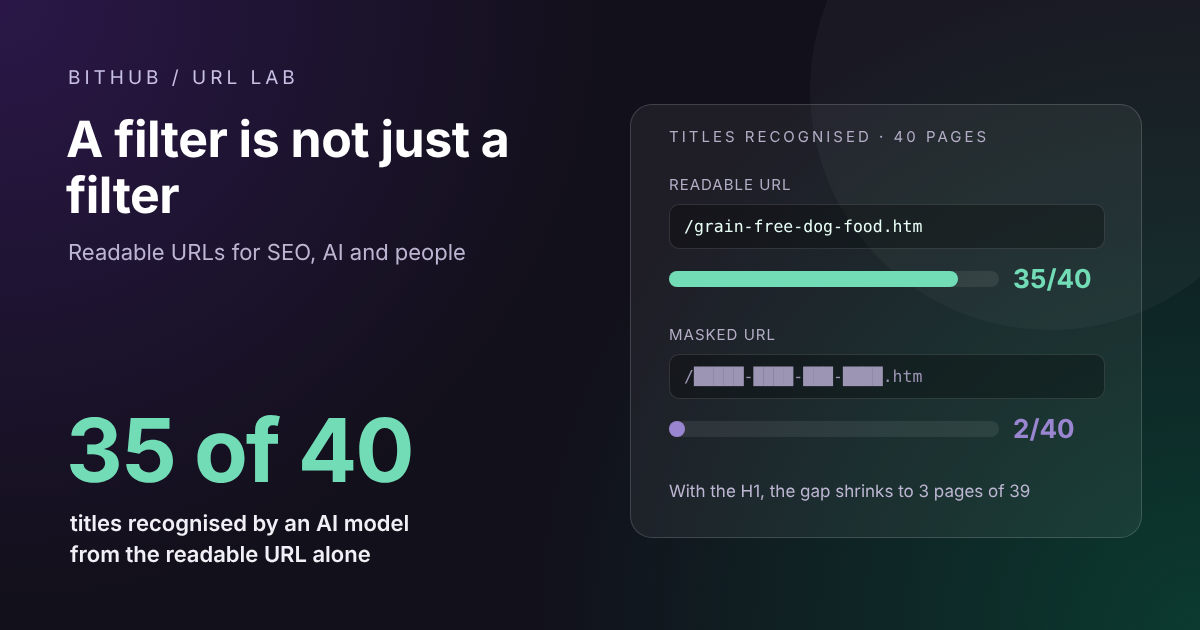
An eCommerce architecture can turn a selection of products into a topic page with an understandable address, an H1 and dedicated copy. A BitHub experiment on 40 pages measures how much the words in a URL are worth to an AI model. The next step is to understand why the same principle can be useful for filtered categories too — and what conditions it needs to really work.
BitHub Observatory · Experimental study and technical analysis · 27 October 2026
The difference between applying a filter and building a page
A visitor wants to buy grain-free dry food for an adult dog. In many shops they open the general category, select a few filters and end up with a list of products along with a technical address, perhaps with several parameters. It works: the catalogue narrows down. But the address, taken on its own, may say little to someone who receives it in a chat or to software that analyses links without downloading the whole page.
The approach described by BitHub is different: products, categories and filter combinations can be represented by URLs close to the domain root, with readable words and specific editorial metadata. Each filter or combination gets dedicated SEO copy, an H1 and a meta title consistent with the selected result. The substantive difference is not dressing a filter up as a category, but giving the selection an explicit editorial meaning that people and automated systems can recognise.
Consider two illustrative examples, not URLs from real shops: /grain-free-dog-food.htm and /catalog?category=12&type=7&grainfree=1. They can lead to the same range of products, but the first communicates the topic immediately; the second needs a key to its parameters. A descriptive URL does not guarantee indexing or rankings. It can, however, contribute to a coherent set of semantic signals together with content, links and structured data. [1][2]
Close to the root: a practical advantage, not an automatic ranking bonus
BitHub URLs tend to keep products and topic pages close to the root, avoiding many technical levels. This choice can simplify addresses, keep slugs more stable when the taxonomy changes and make sharing easier. But a single segment after the domain does not automatically make a page more important to Google. The official guidelines recommend understandable URLs and a logical structure; how pages are discovered and how relevant they are also depends on internal links and their anchor text. [1][3]
It is essential to distinguish URL depth from navigation depth. The page /grain-free-dog-food.htm can sit one level from the domain and still be practically invisible if no internal link reaches it. Conversely, /dog/food/dry-food/grain-free/ can be an authoritative, easily discoverable page if it sits within a good navigation structure. A site with flat URLs therefore has to communicate its hierarchy through categories, anchor text, contextual links and breadcrumbs, not just through the slug. Google even advises that BreadcrumbList structured data should reflect the user's typical path, with no obligation to mirror the URL's directories. [3][4]
The distinctive advantage: pages for search intents, not just filtered results
Being able to give each combination its own H1, title and copy opens an interesting path: turning commercially meaningful selections into landing pages. Think of a general "dry dog food" category, a "grain-free dry dog food" selection and a more precise "grain-free dry food for adult dogs". If each one answers a distinguishable need, shows a relevant range, explains criteria and differences and receives adequate internal links, the value does not lie merely in having changed the URL.
The page can help a user understand which products to choose, why they are included, who they suit and how they differ from the alternatives. The dedicated copy should answer concrete questions, not just swap a few keywords into a repeated template. The title describes the content in search results; the H1 organises the visible topic and makes it recognisable; the meta description, when it exists and is relevant, can contribute to the snippet but does not guarantee that Google will use it. [5][6]
The opportunity is especially interesting for the long tail: combinations of brand, species, need, size, material, use or purpose can match narrower searches than those for the parent categories. Naturally this match has to be verified with keyword research, impressions, product range and user behaviour: not every technically possible combination deserves an indexable landing page.
What we measured: the BitHub test on 40 URLs
To measure the informational value of a URL, rather than just describe it, the BitHub Observatory drew a sample of 40 pages (20 categories and 20 products) from 98 URLs with a valid HTML title, collected from 29 eCommerce sites. The starting corpus contained 253 URLs, 124 of them inner pages. The domains were replaced with the neutral domain shop.example so that the shop's name would not hint at the answer.
The model qwen2.5:7b, run locally through Ollama with no web access, had to identify the correct HTML title among four alternatives, with the option to abstain. For the same pages we created readable URLs, URLs with the words masked and runs with no URL at all; in two further conditions the H1 was provided too. 200 answers were processed. The reference for scoring was the HTML title recorded by Chrome, not a general human judgement of page quality.
| Experimental condition | Correct answers | Sample |
|---|---|---|
| Readable URL only | 35 (87.5%) | 40 |
| Masked URL only | 2 (5.0%) | 40 |
| No URL | 0 (0.0%) | 40 |
| Readable URL and H1 | 34 (87.2%) | 39 with an H1 available |
| Masked URL and H1 | 31 (79.5%) | 39 with an H1 available |
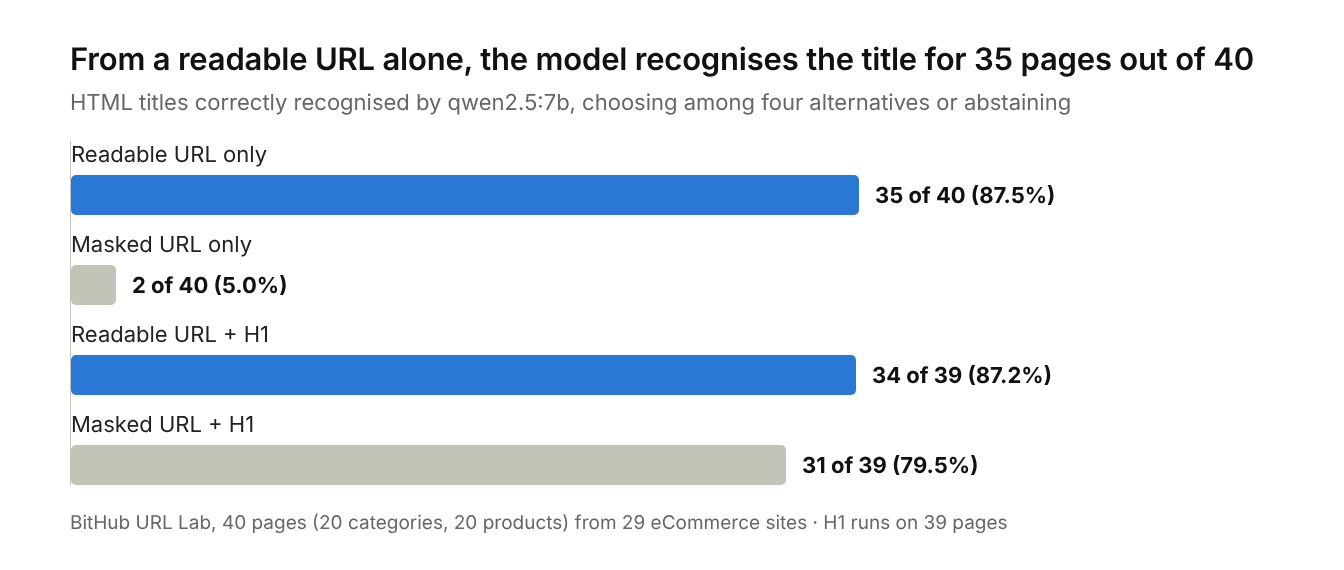
From the readable URL alone, the model correctly identified the title in 35 cases out of 40, against 2 out of 40 with the words masked. In the 33 cases where the readable path corrected a wrong answer or an abstention from the masked path, no change in the opposite direction occurred. It is a strong result for this experimental task: the address contains information that a model can use without opening the page.
Not all of the explanation lies in the AI. A deterministic classifier based on word overlap between the path and the titles had already recognised 31 cases out of 40 (77.5%). There is no need, then, to credit a sophisticated model with the ability to use words that are already there in plain sight in the address.
When the H1 is available, the URL adds less
The runs with the H1 are even more instructive. Among the 39 pages with an H1 actually observed, Qwen chose the correct title in 34 cases with a readable URL and in 31 with a masked URL: three differences in favour, none against, an exploratory advantage of 7.7 percentage points. The three improved cases were category pages; for the 19 product pages with an H1, every answer was correct in both conditions.
This tempers the more emphatic claims about URLs: when the system already has a strong textual signal, the path's marginal contribution can be modest. In addition, the prompt for the H1 runs contained an ambiguous introductory instruction ("You only have the path shown") despite including the H1. The comparison with the H1 should therefore be repeated with corrected wording before it is treated as a conclusive estimate.
The defensible experimental conclusion is precise: a readable URL works as a small summary when the content is not yet known; once title, H1 and copy are available, what counts is the consistency of the whole.
SEO and generative search: a shared foundation, not a GEO trick
On a well-designed BitHub page, an automated system can find several aligned layers of description: slug, internal links, H1, title, topic copy, product selection and, where applicable, structured data. This architecture is potentially useful both to a traditional search engine and to a system that retrieves documents to generate an answer. But it is not correct to claim that Google or AI assistants "do not notice" the filters. They can recognise a filtered list, compare its content with other pages and decide whether it is worth keeping or citing.
Google states that there is no technical GEO shortcut to appearing as a source in AI Overviews and AI Mode: the page must be eligible in traditional Search, indexed and able to offer accessible, useful content. The same documentation points to internal links, available text and structured data that matches the page. BitHub's strategic advantage therefore lies in making a specific answer to a specific need retrievable and understandable, not in hiding the technology used to produce it. [7]
Our test did not measure rankings, impressions, clicks from Google, citations in chatbots, AI crawling or conversion rates. It would be misleading to turn the lab's 87.5% into a forecast SEO or GEO uplift. Rather, the result provides a verifiable reason to design readable links and a hypothesis to be tested against real traffic.
More readable for people: the link outside the results page
A URL is often a visible part of communication: it gets pasted into WhatsApp, an email, a support chat, the text of a quote or a forum. An address such as /shampoo_kerastase/ conveys a topic; one full of IDs, parameters and temporary codes may not. A real product page from our sample, /hill-s-prescription-diet-metabolic-12-kg-per-cane.htm, lets the reader anticipate brand, product line, weight and intended use before clicking, at least for an Italian speaker.
Readability can make orientation easier, support informed trust, help links fit into messages and make it possible to check whether a link looks relevant. It is also useful in editorial material, guides, backlinks and customer support, where links are often read out or copied by hand. We did not measure any increase in CTR or conversions due to shorter URLs, so these remain plausible usability benefits, not percentages attributable to the experiment.
A query string is not automatically a flaw: Google routinely handles properly structured parameters, and in some cases they are a functional choice. The problem arises mainly from redundant parameters, session identifiers and many versions of the same content. The goal is not to abolish the ? character, but to have a stable, readable canonical reference for pages that have lasting value. [1][2]
Other benefits of the architecture, beyond the keyword in the URL
When the same content is reachable through a consistent canonical path, it is easier to include it in a sitemap, link to it from articles, preserve it through changes in sort order and analyse it in Search Console without scattering the data across many variants. Simplicity can also make it easier to debug redirects, manage migrations and recognise the most valuable pages in the logs, provided slugs are stable and changes follow a proper redirect policy. Google explains that canonicalisation exists precisely to choose representative versions and to consolidate some signals across duplicates. [8]
An architecture like this makes it easier to create cross-cutting editorial paths: a guide on a specific need can link directly to an already relevant product selection; a category page can suggest combinations with real demand; breadcrumbs can preserve the logical hierarchy even when URLs are flat. The most valuable contribution is not removing characters from the address bar, but the ability to link search intent, content, product range and internal links in a stable way.
For the people who manage the catalogue, too, separating strategic combinations from mere temporary preferences makes it easier to govern titles, descriptions, updates, performance and quality. Explicit editorial management does not automatically mean original content, though: writing very similar copy for thousands of combinations risks cancelling out the advantage.
The opposite risk: thousands of near-identical landing pages
Faceted navigation is one of the most complex crawling problems in eCommerce. Google documents that excessive filter combinations can produce practically infinite URL spaces, absorbing resources and slowing down the discovery of useful pages. Adding a readable URL, a title and an H1 to every variant does not solve the duplication problem if the product range and main content remain almost identical. Pages created in bulk to target tiny queries can also run into quality problems or fall foul of the policies on doorway pages and scaled content abuse. [9][10] We have covered this in more depth in our guides on which facets to index and which to block and on canonical tags for variants and filters.
The right principle is to distinguish two sets. The first includes strategic filters, tied to different intents, relevant products, useful content and verifiable demand: these are candidates for stable canonical URLs, internal links and — after checking — indexing. The second includes utility combinations (sort orders, occasional options, selections with no products, redundant variants): these must be handled so that they do not needlessly multiply the pages to be crawled. Having an engine that can generate copy for any combination is therefore not enough; you need an editorial and technical policy to decide which combinations deserve visibility.
Google's documentation recommends a stable order for filters encoded in the path, no duplicate attributes and an HTTP 404 status for combinations that do not exist or have no results. The canonical of a genuinely distinct landing page should not automatically point to the parent category, because that would contradict its purpose; for substantially duplicate variants, on the other hand, a coherent consolidation strategy is needed. Robots blocking, noindex and canonical are not equivalent and must be chosen according to the goal. [8][9]
The conditions for BitHub's strategy to deliver measurable SEO value
For a filtered page that is meant to stand on its own, the ideal design combines a permanent slug, a single preferred canonical URL, a consistent title and H1, specific high-quality copy, a genuinely relevant product range, an accessible HTML response, HTML <a href> internal links, and sensible navigation and breadcrumbs. Where appropriate, correct structured data and a selective sitemap can complete the picture. None of these elements, on its own, guarantees indexing, nor is any of them enough to show that the page will be cited in AI answers. [3][4][7]
To measure the real benefit, BitHub can compare a group of strategic filtered landing pages with comparable pages that have not been curated, first checking that there are no substantial differences in product range and linking. The observable variables should include indexing and the canonical chosen by Google, impressions and clicks for specific queries, visits from search engines, crawl behaviour in the logs, traffic to product pages and conversions. For AI search, a visibility and citation protocol repeated over time would be needed, distinguishing between detection of the page and its subsequent selection as a source. That would be a third experiment, different from our linguistic test and more directly tied to the stated commercial advantage.
If you are planning or rebuilding your catalogue, this is the work we do in eCommerce development and as SEO specialists for eCommerce: deciding which combinations deserve a page, writing their content and measuring the results. For an example of the method and the data collected on a real catalogue, see our eCommerce SEO migration case study.
Conclusion: URLs are not powerful on their own — what they represent is
The BitHub study showed that, when the content is not available, a language model can recognise the destination of a readable URL far better: 35 correct titles out of 40, against 2 when the words in the path are erased. With the H1 already available, the observed advantage drops to three cases out of 39. It is a result that argues against both blanket scepticism and miracle promises about GEO.
The most interesting prospect of BitHub's architecture lies elsewhere: making sure that a useful combination of filters can become a real page, with an understandable name, relevant content, distinctive metadata, selected products and internal links. It is a strategy that can help visitors find their way and lay better foundations for content discovery. The actual SEO or GEO advantage, however, will depend on quality, uniqueness, indexing and measured results, not on mere proximity to the root or on the search engine being unable to recognise a filter.
Method and limitations
Purposive sample of 40 pages (20 categories, 20 product pages) from 29 eCommerce sites, selected from 98 URLs with a usable HTML title observed on 26 October 2026. Model qwen2.5:7b run locally via Ollama, temperature 0; four candidate titles per run, with the option to abstain. 200 answers in total across the five conditions; the H1 comparison excludes one page with no observed H1. The masked URLs were synthetic. The results measure controlled title matching, not rankings or AI citations; the choice of candidates and the wording of the prompt may affect the outcome. The marginal comparison with the H1 remains exploratory; in the 39 pairs with an H1 the three discordant cases all favour the readable URL, but an exact two-sided paired test gives p = 0.25. The description of BitHub's filtered landing page features is based on the architecture as reported by the people responsible for it and is not an independent audit of their indexing.
Sources
- Google Search Central — URL Structure Best Practices: developers.google.com/search/docs/crawling-indexing/url-structure
- Google Search Central — Designing a URL Structure for Ecommerce Sites: developers.google.com/search/docs/specialty/ecommerce/designing-a-url-structure-for-ecommerce-sites
- Google Search Central — Link Best Practices: developers.google.com/search/docs/crawling-indexing/links-crawlable
- Google Search Central — Breadcrumb structured data: developers.google.com/search/docs/appearance/structured-data/breadcrumb
- Google Search Central — Title links: developers.google.com/search/docs/appearance/title-link
- Google Search Central — Snippets and meta descriptions: developers.google.com/search/docs/appearance/snippet
- Google Search Central — AI features and your website: developers.google.com/search/docs/appearance/ai-features
- Google Search Central — Canonicalization: developers.google.com/search/docs/crawling-indexing/consolidate-duplicate-urls
- Google Crawling Infrastructure — Managing faceted navigation: developers.google.com/crawling/docs/faceted-navigation
- Google Search Central — Spam policies, doorway and scaled content abuse: developers.google.com/search/docs/essentials/spam-policies
The cases, blind prompts, model answers and the verification table for the 40 pages are available for anyone wishing to replicate the study.
Frequently asked questions about readable URLs and eCommerce filters
Does a short URL close to the root rank better?
There is no documented ranking bonus for being close to the root. Google recommends understandable URLs and a logical structure, but how a page is discovered and how important it is depend above all on internal links, their anchor text and the content.
Should every filter combination get its own indexable page?
No. Only combinations with a distinct search intent, relevant products, useful content and verifiable demand deserve a stable canonical URL. Sort orders, redundant variants and selections with no products should be handled so that they do not multiply the pages to be crawled.
Do readable URLs help AI assistants understand a page?
In our test, a locally run model recognised the correct title for 35 pages out of 40 from the readable URL alone, against 2 out of 40 with the words masked. When the H1 was also available, the advantage fell to 3 cases out of 39. We did not measure real citations in chatbots.
Is a URL with parameters a problem for Google?
Not automatically: Google handles correctly structured parameters. Problems come from redundant parameters, session identifiers and many versions of the same content. Pages that have lasting value need a stable, readable canonical reference.