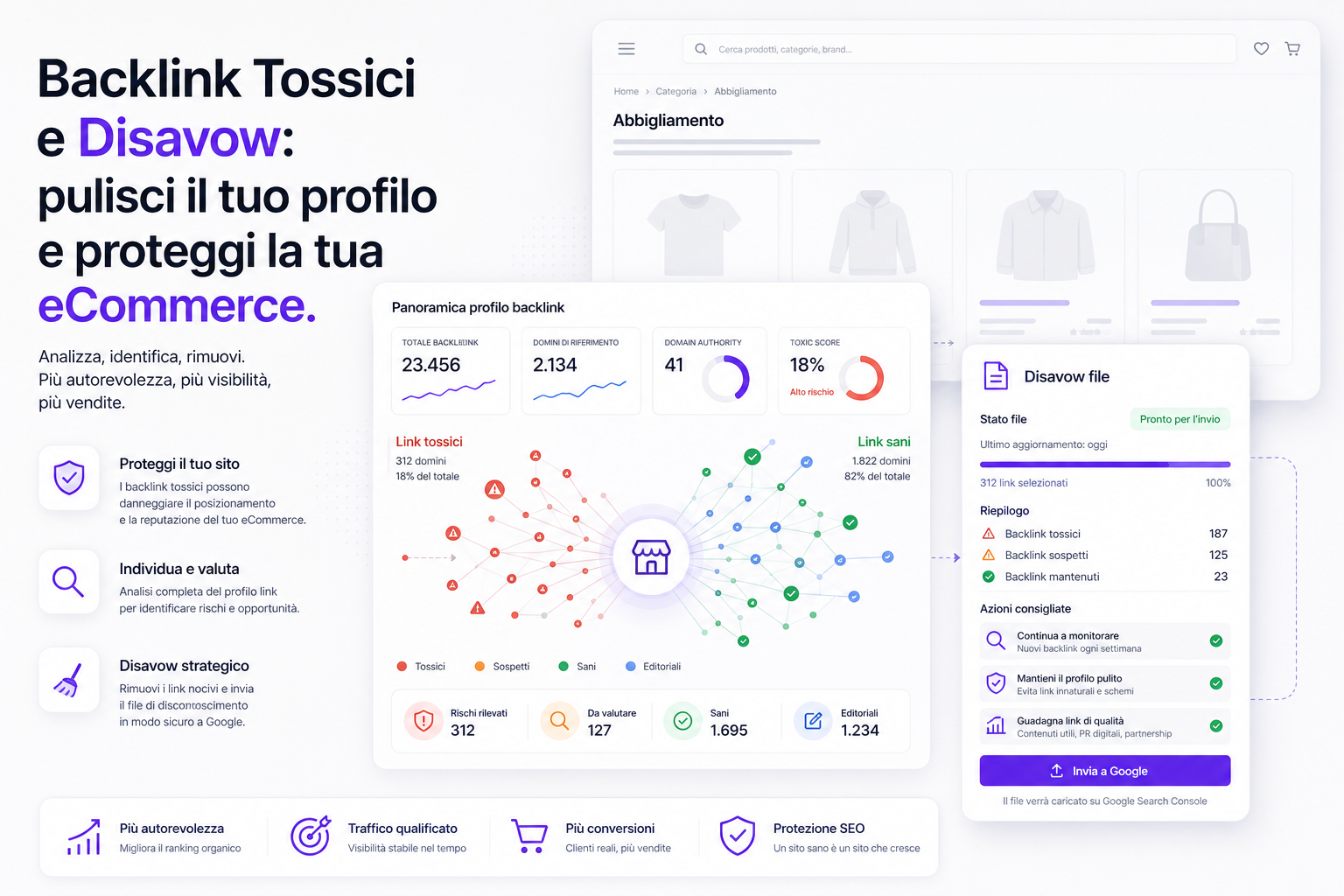
Disavow is not a magic button for "cleaning up" your SEO. It is a delicate tool, to be used only when there are concrete reasons. Use it badly and you risk stripping value from links that were genuinely helping the site. Ignore it when it is needed and you can leave a serious problem unresolved.
On eCommerce sites the subject is even more sensitive. A dirty backlink profile can come from old SEO agencies, bought link packages, PBNs, automated directories, scraping, compromised domains, campaigns run years earlier, or attempts to manipulate organic growth.
The point, though, is this: not every ugly link is an emergency. The web is full of strange links. Google is often perfectly able to ignore a lot of useless signals. The real skill lies in telling noise, risk and actual damage apart.
What toxic backlinks are
"Toxic backlinks" usually means inbound links that look artificial, manipulative, out of context or of very low quality.
Typical examples:
- links from sites created solely to sell backlinks;
- PBNs with no real editorial value;
- links from hacked or compromised pages;
- unnatural, aggressive anchor text;
- foreign domains with no relation to your market, language or sector;
- sitewide links dropped into suspicious footers or sidebars;
- automated directories full of random sites;
- mass-produced articles with thin copy and commercial links;
- networks where every page links to completely unrelated sectors.
A single suspicious link rarely tells the whole story. The problem arises when the pattern is broad, repeated and consistent with a manipulative strategy.
We also covered this in the article on spam backlinks, PBNs and fake boosts in eCommerce: the risk isn't just "having ugly links", it's building apparent SEO growth on fragile signals.
When an ugly link isn't necessarily a problem
Plenty of SEO tools assign a risk score to domains. That's useful as a first filter, but it shouldn't decide for you.
A link can look bad because:
- it comes from a small site;
- it comes from a domain with little traffic;
- it is nofollow;
- it was created by a scraper;
- it appears on a poorly maintained page;
- it is an old link with little value;
- it comes from a site the tool doesn't know well.
That doesn't automatically mean you should disavow it. A serious audit doesn't take the tool's "toxic links" export and upload it to Search Console. It first looks at context, volume, the site's history, manual actions, traffic trends, anchor text, the pages affected and where the links came from.
Toxic-backlink panic has become almost a commercial product. Some consultancies sell "link clean-ups" as if they were routine maintenance. But a clean-up done without judgement can turn into pruning in the dark.
What the disavow file is
The disavow file is a text file that tells Google which URLs or domains you want ignored as signals for your site.
In practice, you can list:
- individual suspicious pages;
- whole domains, using the
domain:prefix; - internal comments in the file, using
#at the start of the line.
For example:
# Domains to disavow after the backlink audit
domain:example-spam.com
domain:artificial-link-network.example

# Specific URLs
https://spam.example/page-with-link.html
The file is uploaded to the Search Console disavow links tool. Google then has to reprocess those signals, and that can take time. It isn't an instant switch and it doesn't guarantee an automatic recovery of rankings.
When Google actually recommends a disavow
Google's official documentation is cautious. In short: most sites do not need to use this tool.
A disavow mainly makes sense when both of these conditions are present:
- a considerable number of spammy, artificial or low-quality links pointing at the site;
- a manual action in place, or a concrete risk that those links could cause one.
Google also suggests trying to have the spammy or low-quality links removed from the web first, where that's possible. If you can't get them removed, the disavow can then become the right tool.
Translated for an eCommerce owner: don't upload a disavow just because you have seen a few ugly domains. Upload one when the audit shows a serious, documented problem tied to practices that breach the link policies.
When a disavow risks doing damage
The biggest risk is disavowing good links along with the bad ones.
That can happen when:
- you use a tool's toxic score automatically;
- you don't distinguish between nofollow, sponsored, UGC and follow links;
- you disavow entire domains without looking at the actual pages;
- you don't check whether a link brings traffic or useful citations;
- you don't know whether that link came from PR, a partnership, a marketplace or old editorial content;
- you upload a new file and accidentally replace the previous one;
- you don't keep a historical copy of the versions you have uploaded.
An over-aggressive disavow can remove signals that were helping the site. An over-timid one can fix nothing at all. That's why it shouldn't be done on instinct. It should be done with method.
How to analyse an eCommerce backlink profile
For an eCommerce site, the analysis has to look at several levels.
1. Where the domains come from
Where are the links coming from? Are they sites consistent with your market, language, category and audience? Or are they themeless domains, out of context and stuffed with random commercial links?
2. Anchor text
Is the anchor text natural? Does it cite brand, URLs, products and content in a reasonable way? Or is it full of bare keywords, unnatural phrases or link-selling jargon?
3. Destination pages
Do the links point to the homepage, to categories, to products, to old URLs or to odd pages? A pattern of artificial links towards specific commercial pages is more suspicious than a few random links to the homepage.
4. Growth over time
Has the link profile grown gradually, or has it had sudden spikes? Do those spikes coincide with SEO work, migrations, drops, manual actions or the purchase of link packages?
5. Link types
Follow, nofollow, sponsored, UGC, redirects, images, sitewide links: they don't all carry the same weight and they shouldn't all be read at the same level of risk.
6. Search Console signals
Are there manual actions? Security messages? Sudden drops? Indexing problems? The link profile should be read alongside Search Console, not in isolation inside a tool.
If you only look at a table of "toxic links", you lose the context. And without context, a disavow becomes a gamble.
Toxic backlinks, or a structural problem?
Plenty of eCommerce businesses look for the cause of an SEO drop in their links, but the problem is often somewhere else.
Before blaming the backlinks, you should check:
- weak or duplicated categories;
- indexable filters that are badly managed;
- wrong canonicals;
- out-of-stock products handled with no strategy;
- migrations without complete redirects;
- dirty sitemaps;
- slow pages;
- generic content;
- poor internal linking;
- falling demand or seasonality.
We have written specific guides on Search Console and the signals that precede an SEO collapse, eCommerce canonicals and eCommerce filters and SEO precisely because links are only one part of the picture.
If the structure is weak, disavowing a few domains will not turn a fragile eCommerce site into an authoritative one.
What to ask your SEO agency
If your agency starts talking about toxic backlinks or disavow, ask these questions before approving any work.
- Which links are genuinely dangerous, and why?
- Is there a manual action in Search Console?
- Has the site bought links or used PBNs in the past?
- Is the disavow file based on a manual audit or just an automated export?
- Have you separated domains to keep, to monitor and to disavow?
- Why disavow the whole domain rather than a single URL?
- Are there editorial links or partnerships at risk of ending up in the file?
- Do you have a copy of the old disavow file?
- Who owns the Search Console property?
- What do we expect after the upload, and over what timeframe?
- Which technical or content problems are we fixing besides the links?
- How will we monitor traffic, rankings, affected pages and Search Console messages?
If the answer is "the tool marks them toxic, so we disavow them", I'd stop there. SEO isn't done with an automatic traffic light.
How we handle it at BitHub
When we analyse backlinks and disavow, we start from a simple question: are we solving a real problem, or just chasing a fear?
Our approach is this:
- check Search Console, manual actions and organic trends;
- analyse the backlink profile with several sources, not a single tool;
- classify the suspicious patterns manually;
- separate spam links, useless links, links to monitor and links to keep;
- verify old SEO activity, PR, partnerships and migrations;
- produce a documented, versioned disavow file if one is warranted;
- monitor after the upload;
- work in parallel on structure, content, categories, filters and performance.
For us the disavow isn't the strategy. At most it's one tool inside a broader strategy. The real advantage still comes from building a technically solid eCommerce site, with useful pages, clean URLs, commercial content, internal linking and clear data.
This connects to our work on custom eCommerce, SEO and Google Ads and eCommerce category page SEO. External links help when they have something solid to support.
Useful sources
For a deeper look, start with Google's official documentation on the disavow links tool, the Google Search spam policies and the best practices for links and anchor text.
FAQ
Should I disavow every toxic link an SEO tool flags?
No. A tool's risk score is a starting point, not a decision. First you need a manual audit that weighs context, volume, anchor text, destinations, the site's history and Search Console signals.
Does a disavow improve rankings straight away?
No. The file has to be reprocessed by Google and that can take weeks. Besides, a disavow doesn't create new value: at best it reduces the effect of problematic links. If the site has technical problems or weak content, those have to be fixed separately.
Should nofollow links go in the disavow file?
Usually not, except in particular cases inside a highly suspicious pattern. A nofollow link shouldn't be read as a follow link. Here too you need context, not automation.
Is it better to disavow individual URLs or whole domains?
It depends. If the entire domain is clearly spam or part of a manipulative network, using domain: often makes sense. If the problem concerns only one page, the URL can be enough. The choice should be documented.
Is disavow useful against negative SEO?
It can help only in very specific, documented cases. Google tends to ignore a lot of external spam signals, so there's no need to react to every ugly link. If the volume and the pattern are genuinely anomalous, though, a serious audit is warranted.
Can an eCommerce site grow without buying backlinks?
Yes, especially if it works on structure, categories, filters, useful content, performance, structured data and internal linking. Quality backlinks help, but packages of spam links are not a solid strategy.
Want to know whether your backlinks are a real risk?
We can analyse your link profile, Search Console, organic traffic, affected pages and eCommerce structure. The goal isn't to clean up at random, but to work out where action is genuinely needed.