
Google Ads automation can optimise bids and budget distribution, but it cannot correct a wrong commercial objective on its own. If the account treats a cart, an irrelevant phone call or a duplicate purchase as a conversion, the algorithm becomes very efficient at chasing the wrong signal.
A specialist's job isn't to fight the automation. It is to feed it reliable data, keep an eye on what it is learning, and connect campaigns, feed, site, orders, returns and margins. This case shows what can change when the main measure goes back to being verified revenue, rather than the most flattering number on the dashboard.
In short: what changed
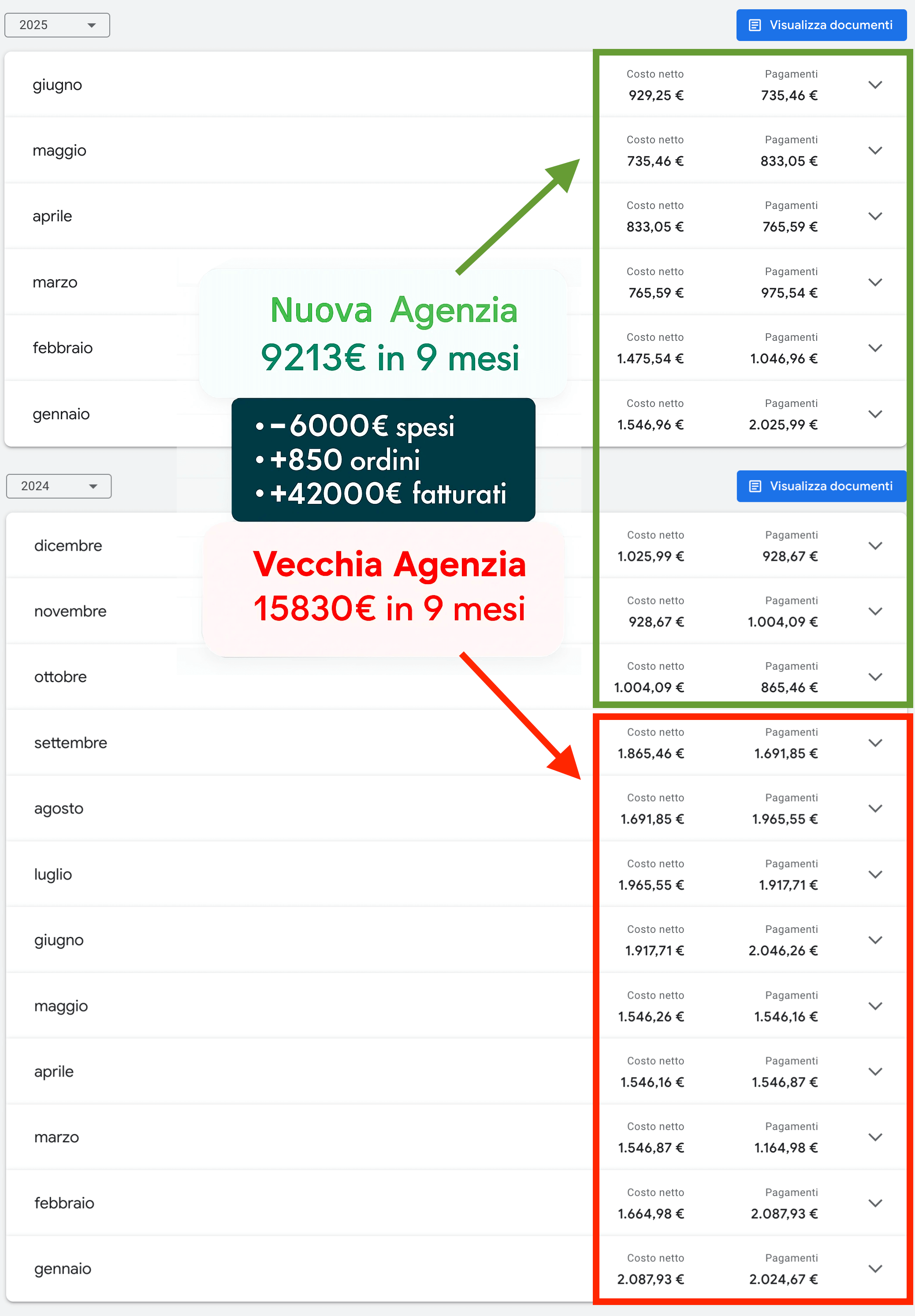
- Google Ads budget cut from €15,830 to €9,213;
- attributed and verified orders up from 2,008 to 2,850;
- attributed revenue up from €85,583 to €127,796;
- non-commercial conversions separated from real purchases;
- products and campaigns analysed by performance, catalogue and economic sustainability.
The two periods compared are the same length, nine months, but this is not a controlled A/B test: they cover different seasons and can be influenced by prices, demand, availability and the market. The numbers do not prove that a single change produced the whole improvement. What they do show is that, with less spend, the sales system recorded more orders and more revenue in the later period.
The case: same eCommerce site, less budget and more verified orders
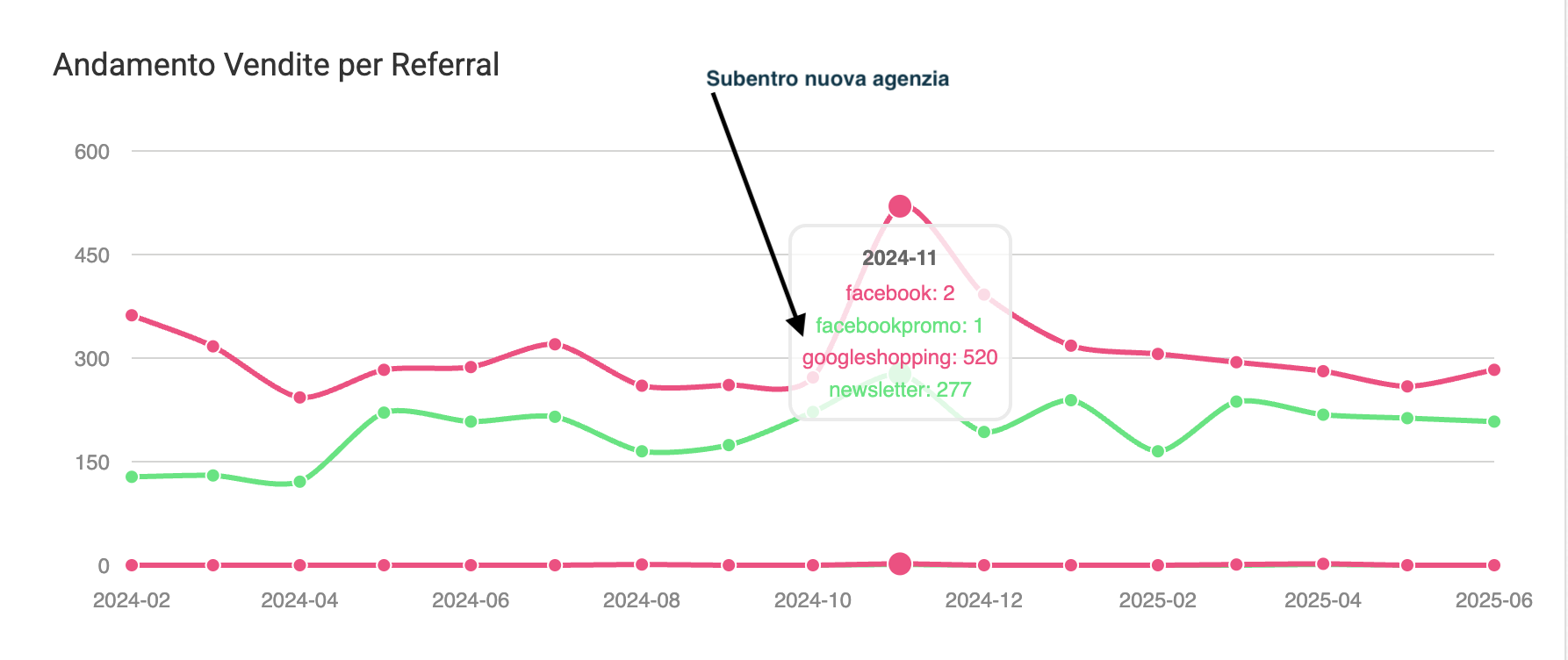
The client, an eCommerce business with no physical stores, brought us in after months of campaigns they considered inefficient. The account contained actions such as phone calls, even though that type of contact did not represent the main purchase process. Adding up different signals made it hard to see which campaigns were actually generating orders.
The initial constraint was clear: cut the budget. Before touching bidding, we separated the events useful for diagnostics from the conversions to be used for optimisation, comparing the Google Ads data with the orders and revenue recorded by the site.
| Period | Ads spend | Verified orders | Attributed revenue |
|---|---|---|---|
| January - September 2024 | €15,830 | 2,008 | €85,583 |
| October 2024 - June 2025 | €9,213 | 2,850 | €127,796 |
First correction: orders as the primary conversion
An eCommerce account can measure product views, add-to-carts, checkout starts, phone calls, sign-ups and purchases. They are all useful events for understanding the journey, but they don't all have to carry the same weight in optimisation.
Purchases have to arrive with a consistent transaction ID, value and currency. The ID helps limit duplicates; the value lets you tell different orders apart; comparison with the ERP helps identify cancellations and anomalies. In the article on misleading Google Ads ROAS we collected the checks you need when advertising revenue doesn't match the real thing.
Carts and checkouts remain diagnostic signals. Using them as the primary goal without a specific reason can shift budget towards users who are good at starting the journey but not at finishing it. It is the same problem analysed in the guide on Performance Max, carts and orders.
Second correction: reading products, margins and stock
Google knows what it receives from the feed and the tracking, not the company's full economic context. Two products with the same revenue can have very different margins, availability, shipping costs and return rates.
That is why we worked by segments: brand, categories, historical performance and availability. Google Shopping custom labels can carry information such as margin band, seasonality, sell-through speed or commercial priority into the feed. They aren't there to manipulate the algorithm, but to give it a structure that reflects the catalogue.
Products with no stock, incomplete data or a slow page don't automatically deserve more budget. First you fix the feed, the landing pages and the purchase process; then you consider increasing spend.
What automation does well
Smart Bidding and automated campaigns can process a lot of signals and react to each individual auction faster than a human operator. They can be effective when:
- conversion volume is sufficient and stable;
- value, currency and transaction ID are correct;
- the Merchant Center feed is up to date;
- budget and targets are compatible with the purchase cycle;
- campaigns don't mix products with opposite economics;
- returns and cancellations are taken into account in the analysis.
The point isn't choosing between a person and an algorithm. It is assigning different responsibilities: automation handles the auctions, the specialist governs data, structure, exclusions, creative, feed and objectives.
Where the specialist's control is needed
- Defining conversions: distinguishing purchases, micro-conversions and diagnostic signals.
- Data quality: checking duplicates, values, consent, attribution and differences against the ERP.
- Catalogue economics: reading margins, stock, returns, seasonality and business priorities.
- Search terms: working out whether the queries are consistent with the products and purchase intent.
- Landing pages and checkout: not asking campaigns to compensate for slow pages or unclear offers.
- Experiments: changing one lever at a time where possible and noting what changes.
Our eCommerce Google Ads audit checklist goes into detail on these checks. For suspicious cases it also helps to connect forms, CRM, logs and GCLID, as explained in the analysis of Google Ads click fraud.
Google Ads for companies without an eCommerce site too
The same principle applies to lead generation and B2B. A submitted form is not the same as a sale. When the commercial cycle continues in the CRM, it helps to import statuses such as qualified lead, quote accepted or contract signed, respecting the technical requirements and consent.
The Google Ads Specialist page describes our work both for eCommerce and for companies selling services. The data that drives optimisation has to get as close as possible to the real financial outcome.
Frequently asked questions
Should Google Ads automation be turned off?
No. Smart Bidding and Performance Max can be useful, but they have to receive correct conversions, reliable values, clean feeds and constraints consistent with margins and commercial goals.
Does a high ROAS prove the campaigns are working?
Not always. ROAS can be inflated by duplicate conversions, carts counted as sales, returns that aren't deducted, brand demand you already had, and incorrect order values.
What data do you need to run Google Ads for an eCommerce site?
At a minimum you need valid orders, correct value and currency, a transaction ID, return status, product data, margin or margin bands, and a reliable Merchant Center feed.
Do you also run Google Ads for companies without an eCommerce site?
Yes. For lead generation and B2B we connect campaigns, site and CRM, importing commercial outcomes where possible instead of optimising only for forms and phone calls.
Request a review of your campaigns, conversions and eCommerce data