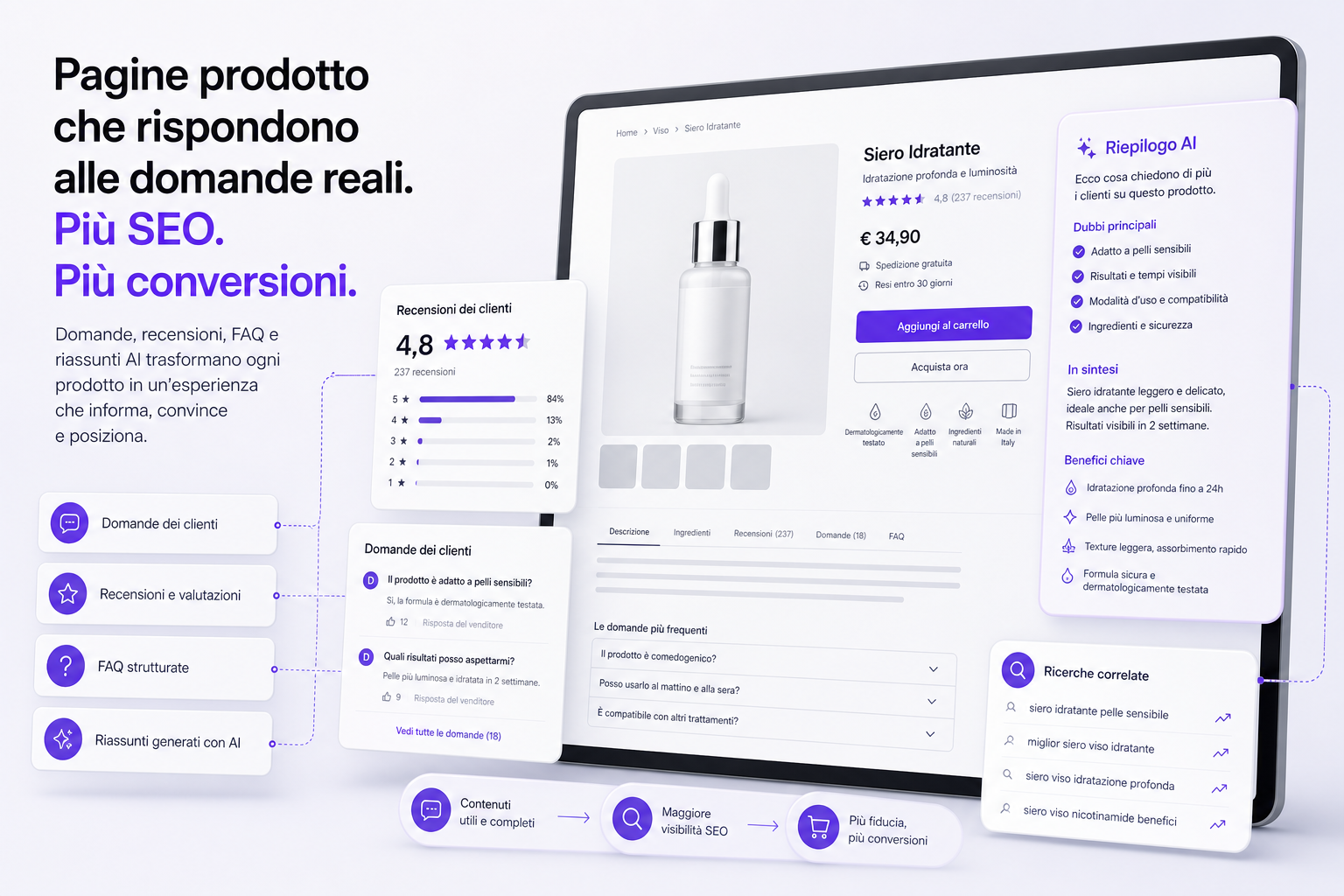
Customer questions and reviews aren't a detail to dump at the bottom of the product page. They are often the part closest to the moment a person decides whether to buy or walk away.
When a user lands on a product page, they rarely look only at the price and the photos. They look for reassurance. They want to know whether the product suits their case, whether other customers were happy with it, whether there are recurring faults, whether the size is right, whether the ingredient is compatible, whether the material holds up, whether the product arrives looking like the images, whether returns are easy.
These questions have double value. They help the user buy with more confidence, and they help Google understand better which searches that page is genuinely useful for.
A product page with no questions, no readable reviews and no concrete answers is often a flat page. A product page that collects real doubts, useful answers and social proof becomes a far stronger commercial page.
Why reviews and Q&A matter for SEO
Many searches aren't as blunt as "product name". They are searches full of doubts:
- "is it suitable for sensitive skin";
- "is it OK for children";
- "real measurements";
- "compatible with";
- "how long does it last";
- "how to wash it";
- "is it noisy";
- "ingredients";
- "does it run large or small";
- "customer opinions".
These queries are often closer to purchase than a generic keyword. Someone searching for "running shoes" is still broad. Someone searching for "running shoes overpronation 85 kg reviews" is looking for reassurance before choosing.
Customer questions capture exactly this long tail. Not because you should fill the page with random text, but because you should answer real doubts with useful, readable content connected to the product.
This connects to the work on product pages with AI, reviews and FAQs and to the wider logic of eCommerce SEO category pages: every page has to have a clear role, not just exist in the catalogue.
Reviews: not just stars
Stars help, but they aren't enough. The real value of reviews lies in the language customers use.
A review can contain information the spec sheet doesn't convey well:
- the product is smaller or larger than expected;
- shipping was fast;
- the material is more durable than it looks;
- the packaging is convenient;
- real-world use differs from what people imagined;
- there are cases where the product isn't suitable;
- value for money is perceived well;
- some customers had the same doubt before buying.
This information is valuable because it reduces uncertainty. And uncertainty is one of the main reasons a user doesn't buy.
The review does have to stay genuine, though. Inventing reviews, manipulating ratings or showing only artificial social proof can do enormous damage to trust. On the SEO side too, structured data for reviews should only be used when the content really is present and consistent with the guidelines.
Customer questions: the most underrated goldmine
Every question asked of customer care is a signal. If ten people ask the same thing, it isn't a nuisance: it is a gap in the product page.
Examples:
- "Is it compatible with model X?";
- "What's the difference between this and the other product?";
- "Is it OK for professional use?";
- "Can I use it every day?";
- "Is the colour true to the photo?";
- "Do I need an extra accessory?";
- "How long does one pack last?";
- "Is it available in other sizes?".
If these answers stay locked in email, chat or WhatsApp, the site keeps losing time and conversions. If they become structured content inside the page, they help new customers, customer care and search engines.
The principle is similar to the one we explained for eCommerce site search with synonyms, typos and AI: the words users choose are commercial data. Don't waste them.
Product FAQs: useful even when the rich result doesn't appear
Many people think of FAQs only as a "rich snippet trick". That's a mistake.
Google has reduced the visibility of FAQ rich results for most sites. That means you shouldn't write FAQs just hoping for the box in the SERP. You should write them because they improve the page, answer doubts and make the product clearer.
A good product FAQ should:
- answer real questions, not ones invented to add volume;
- be specific to that product or product group;
- not mechanically duplicate the description;
- use simple words, close to the ones customers use;
- be updated when the product, returns policy, ingredients, sizes or compatibility change;
- sit in the page, visible to the user, not just hidden in the code.
If the FAQ answers a question customers genuinely ask before buying, it has value even without a rich snippet.
Structured data: Product, Review and Q&A without forcing it
Structured data helps search engines understand the page better, but it shouldn't become a way of declaring things the page doesn't show.
For an eCommerce product page, the most natural markup is often Product, with information such as name, image, offer, availability, price, brand, SKU, and where appropriate aggregateRating and reviews when they are present and consistent.
If the page contains real, visible reviews, it can make sense to use the properties linked to review snippets as well. If it contains a genuine question-and-answer section, it can make sense to consider QAPage markup, but only when the page really does follow that format. If it contains FAQs, remember that having the markup does not guarantee the rich result will be displayed.
The practical rule is this: first build a page that is useful to the user, then add correct structured data. Not the other way round.
How AI can help without wrecking trust
AI can be very useful on product pages, but only if it works on genuine data.
It can help to:
- summarise hundreds of reviews into a few key points;
- extract recurring doubts from customer messages;
- propose new FAQs for review;
- highlight recurring pros and cons;
- flag products with many unresolved questions;
- connect similar questions phrased with different words;
- find long-tail SEO opportunities;
- prepare consistent answers for customer care and chatbots.
The limit is just as clear: AI must not invent reviews, promises, benefits or compatibility. It should summarise, propose and help the team see patterns that would otherwise stay scattered.
In our custom eCommerce work we apply this logic to the catalogue, filters and product pages too. AI can read products, reviews, questions, brands and categories, then suggest useful content that a person reviews and improves over time. We covered this in the article on AI for the eCommerce catalogue, tags, filters and descriptions.
A short example: a product page that doesn't answer
Picture a product page with a title, two photos, a price and a technical description copied from the supplier.
The product may well be good, but the user finds no answer to simple questions:
- is it right for my case?
- how big is it really?
- how do other customers use it?
- are there recurring problems?
- what's the difference compared with the more expensive product?
- if I get it wrong, can I exchange it?
Those unanswered questions become abandonments, customer care tickets, Google searches, comparisons with other sites and lost sales.
Now picture the same page with:
- an AI summary based on real reviews;
- frequently asked questions specific to the product;
- reviews filterable by theme;
- seller answers to the most important questions;
- links to compatible or alternative products;
- FAQs updated by customer care;
- structured data consistent with the visible content.
The page isn't just longer: it is more useful. A more useful page may stand a better chance of satisfying the search, converting and reducing repetitive work; rankings still aren't automatic.
Checklist for a stronger product page
Before thinking about new plugins or Ads campaigns, check these points.
- Are reviews visible on the product page?
- Do the reviews show only stars, or useful text too?
- Do the frequently asked questions answer real doubts?
- Does customer care report the most repeated questions?
- Are the FAQs different by product, category or brand?
- Does the spec sheet explain measurements, materials, compatibility and limits?
- Can the reviews be used to improve the description and the FAQs?
- Is the Product markup correct and consistent with the page?
- Are price, availability and variants up to date?
- Does the AI summarise real data or generate generic text?
- Does the chatbot know the reviews, FAQs and product characteristics?
- Is the content reviewed by a person?
What to ask your agency
If you are rebuilding or optimising an eCommerce site, these questions help you see whether the product page is treated as a genuine commercial page or just as a template.
- How are reviews collected and displayed?
- Are the reviews connected to the Product structured data?
- Do customer questions end up inside the site, or stay scattered across email and chat?
- Can we create different FAQs by product, category and brand?
- Does the system allow content to be updated at scale?
- Can customer care suggest new answers without going through a developer every time?
- Can AI analyse reviews and questions without inventing information?
- Does the chatbot answer using real catalogue data?
- How do we check that price, availability and reviews are consistent?
- Are the product pages fast enough even with reviews and widgets?
- Is the markup validated with official tools?
- Which metrics do we look at: conversion rate, tickets reduced, SEO queries, sales, returns?
If the answer is "the product pages are all the same", you are probably leaving a lot of value on the table.
How we handle it at BitHub
In our work on custom eCommerce sites, reviews, questions, FAQs and AI aren't separate pieces.
The product page can become the point where these come together:
- catalogue and variants;
- brands and categories;
- real reviews;
- customer questions;
- reviewed FAQs;
- SEO content;
- an AI chatbot connected to the catalogue;
- structured data;
- site search;
- reporting on conversions and recurring doubts.
This approach connects to bespoke eCommerce development, to AI automation and to the work on the AI chatbot connected to the catalogue. The advantage isn't having more text. It is having a page that can answer better, sell better and learn from customers.
Useful sources
For the technical side it is worth starting from the official Google documentation on Product structured data, review snippets, Q&A structured data and the changes to FAQ rich result visibility.
FAQs
Do reviews really help SEO?
They can help because they add real content, customer language, trust signals and details that often capture long-tail searches. Having stars isn't enough: you need useful, visible and consistent content.
Can I use AI to write reviews?
No. AI must not invent reviews. It can, however, summarise real reviews, extract recurring themes, propose FAQs and help the team improve the product page.
Do product FAQs still produce rich snippets?
You shouldn't count on that as the main goal. Google has reduced the visibility of FAQ rich results for many sites. FAQs remain useful if they answer real questions and help the user decide.
Should QAPage be used on every product page?
No. QAPage should only be considered when the page genuinely contains a question-and-answer section consistent with that format. For many product pages, Product markup remains the most natural base.
Free-form reviews or guided questions?
You need both. Free-form reviews describe real experience. Guided questions help collect useful information on size, quality, use, compatibility, faults and reasons for buying.
How do I work out which FAQs to add?
Look at email, chat, WhatsApp, site search, reviews, returns, tickets and customer care questions. If a doubt keeps coming back, it probably deserves space on the product page.
Want to turn product pages into pages that genuinely answer?
We can analyse product pages, reviews, customer questions, structured data, AI and conversions. The goal is to build pages that are more useful for buyers and more understandable for Google.