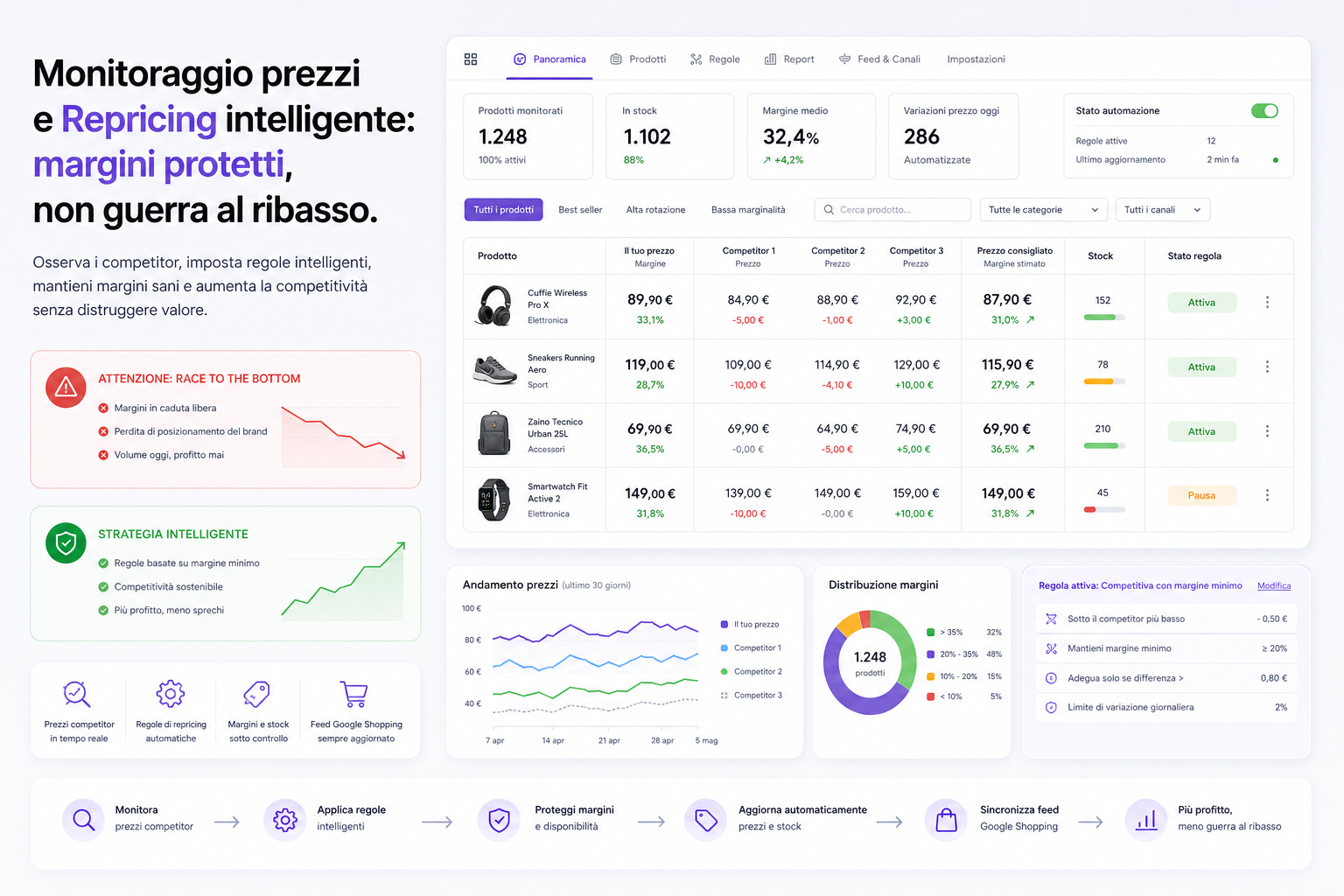
Monitoring competitor prices can help an eCommerce business sell better. But if you do it badly, it turns into a machine for shrinking your margins.
The risk is simple: you see that a competitor is cheaper, so you drop your price too. Then another competitor goes lower, so you go lower again. In the end revenue may grow for a few days, but the profit disappears. You have won the race to the lowest price and lost the one that matters: making money.
Price monitoring is not there to copy the lowest price automatically. It should help you make better decisions: when to compete, when to hold still, when to protect the margin, when to push stock, when to walk away from a price war and when to use price as a strategic lever.
Why monitor competitor prices
In many eCommerce sectors, customers compare. They do it on Google Shopping, marketplaces, comparison sites, competitor websites, newsletters, social media and direct searches.
If you do not know where you sit, you risk making decisions blind:
- you push products that are out of the market with Google Ads;
- you cut prices on products that would have sold anyway;
- you lose sales on strategic products because you are too expensive without knowing it;
- you keep pointless promotions running on products that are already competitive;
- you fail to protect margins on products where you have a genuine advantage;
- you ignore competitors moving into important categories.
Price is not the only reason a customer buys, but it is a very strong signal. And if you run Google Shopping or Performance Max, price, availability, feed and margin become even more tightly connected.
The lowest price is not always the right price
A classic mistake is setting a rule along the lines of "always stay 1 euro below the cheapest competitor". It sounds clever. In practice it can be dangerous.
Why?
- the competitor may have different margins from yours;
- they may be selling at a loss to clear stock;
- they may charge more for shipping;
- they may show false availability or long lead times;
- they may be using that product as a loss leader;
- they may be a marketplace working to different rules;
- they may offer worse service, poor reviews or more awkward returns.
If you automatically follow the lowest price, you are letting the competitor decide your margin. That is rarely a good strategy.
What data you really need to monitor
Price on its own is not enough. A useful monitoring system should collect and compare several pieces of information.
- Product price: current price, promotional price, history of changes.
- Shipping: free, paid, thresholds, estimated delivery times.
- Availability: in stock, out of stock, pre-order, delivery times.
- Genuine competitors: not every site is a direct competitor.
- Product condition: new, refurbished, bundle, different pack.
- Brand and model: a correct match between equivalent products.
- Your internal margin: the minimum price that is sustainable for you.
- Your stock: how much you need to push or protect that product.
- Ads performance: cost, conversions, ROAS, margin and custom labels.
- Demand: seasonality, trends, promotions and availability in the market.
Without this data, price monitoring is just a table full of numbers. With it, it becomes a decision-making tool.
Scraping, APIs and data sources: mind the quality
Price data can come from different sources: APIs, feeds, comparison sites, marketplaces, Merchant Center, controlled scraping or external data providers.
Every source has limits:
- APIs do not always expose everything you need;
- feeds can be updated with a delay;
- scraping can break when a site changes its layout;
- comparison sites do not always show every competitor;
- marketplaces have very different sellers, shipping options and conditions;
- product matching can go wrong when EAN, GTIN or SKU are not reliable.
On top of that, when you collect data from third-party sites you have to respect terms, technical limits, robots.txt where relevant and basic operational common sense. A serious system should not hammer external sites, get around protections or turn price monitoring into aggressive traffic.
Product matching is the heart of the system
Before you even get to price, you need to know whether you are comparing the same product.
The most frequent errors are:
- a similar but not identical product;
- a different pack, for example a single unit versus a multipack;
- a different variant, with a colour or size that does not match;
- a bundle with accessories included;
- an old model versus the new model;
- a missing or incorrect EAN code;
- competitor titles that are badly written or abbreviated;
- availability that is not real.
If the match is wrong, the repricing rule will be wrong too. You could drop the price of a premium product to chase a cheaper version, or believe you are out of the market when you are actually selling a different item.
This is where AI and the catalogue can help: title, description, brand, EAN, images, attributes and categories can be cross-referenced to propose more reliable matches, always with human review on the most important categories.
Repricing rules: automate, but with brakes
Automatic repricing can be useful, but it needs clear limits.
Sensible rules might include:
- never going below a minimum margin;
- not changing the price when the gap to the competitor is too small;
- adjusting only products with high stock;
- protecting high-margin products;
- not chasing unreliable competitors;
- not changing a price more than once a day or once a week;
- avoiding constant fluctuation;
- separate rules for bestsellers, seasonal products, outlet lines and end-of-line stock;
- requiring manual approval above certain thresholds;
- keeping a history of every change and the reason for it.
Good automation does not take blind control of your pricing. It proposes, applies safe rules, flags delicate cases and leaves the team in control of strategic decisions.
Minimum margin: the rule you cannot skip
Every product should have at least a minimum sustainable price. It does not have to be visible to the public, but it has to exist in the system.
That price should take into account:
- cost of goods;
- VAT, where it is relevant to the internal calculation;
- payment fees;
- shipping costs you absorb;
- packaging;
- the average cost of a return;
- estimated Ads cost;
- marketplace fees, where they apply;
- the minimum margin you want.
Without that threshold, repricing can turn into a price war dressed up as automation.
This connects directly to the subject of Google Ads ROAS distorted by margins, returns and cancelled orders: selling more is not enough if you are selling badly.
Stock and pricing have to talk to each other
Price should not be decided on competitors alone. It should also be decided on stock.
For example:
- high stock and a healthy margin: you can afford to be more aggressive;
- low stock: there is no point dropping the price too far;
- end-of-line stock: it can have dedicated rules;
- seasonal products: you need to anticipate demand and its decline;
- products that are slow to restock: be careful not to clear them too early;
- loss leaders: they need watching so they do not drag the whole category down.
That is why price, warehouse and ERP have to communicate. We covered this in the article on eCommerce, ERP, APIs and stock: if the operational data is not reliable, the pricing strategy becomes fragile too.
Google Shopping and Merchant Center: price and availability have to be consistent
If you run Google Shopping or Performance Max, the price does not only live on the site. It lives in the feed as well.
Merchant Center requires consistent product data: price, availability, sale price, currency, images and landing page all have to tell the same story. If you change the price on the site but not in the feed, or if the feed shows different availability from the page, you can trigger disapprovals, degrade data quality and waste budget.
Competitor monitoring can therefore feed Ads decisions too:
- reducing budget on products that are out of the market;
- pushing products that are competitive and profitable;
- creating custom labels for price and margin bands;
- separating products to protect from products to clear;
- understanding where competition is squeezing the margin;
- stopping PMax from investing in products that are not competitive.
The link with Google Shopping custom labels is a natural one here: the feed should not only carry technical data, but useful commercial signals as well.
When you should not cut the price
There are cases where a higher price is justified.
- you ship faster;
- you offer better support;
- you have stronger reviews;
- you genuinely have stock when others do not;
- you have clearer returns policies;
- you sell a more complete bundle;
- the product is strategic for margin or brand reasons;
- the competitor is not very reliable;
- the price gap is tiny and does not change the buying decision.
Price monitoring is also there to stop you reacting when reacting is pointless. Sometimes the smartest choice is to hold still and improve the product page, reviews, FAQs, shipping or communication.
A useful dashboard: what it should show
A pricing dashboard should not just be a list of competitors.
It should show:
- the products being monitored;
- the competitors for each product;
- your price, the competitor price and the gap;
- current margin and minimum margin;
- available stock;
- the price history for you and for competitors;
- the rule applied or suggested;
- the impact on the feed and on campaigns;
- products that are out of the market;
- products where there is room to raise the price;
- cases that need manual approval;
- alerts on unusual changes.
The value lies in prioritisation. You should not be looking at a thousand products every morning. You need to know which twenty deserve attention.
What to ask your agency or your developer
Before you switch on price monitoring or repricing, ask these questions.
- How are the competitors to monitor chosen?
- How do we verify that the product really is the same one?
- How do we handle EANs, SKUs, variants, bundles and different pack sizes?
- What is the minimum margin we cannot go below?
- Which products can be updated automatically and which cannot?
- How often do we update prices?
- How do we avoid constant fluctuation?
- How do we connect stock, the ERP and the Merchant Center feed?
- Do the rules take Google Ads, ROAS and custom labels into account?
- Are there logs of price changes?
- Who approves sensitive price changes?
- How do we respect the technical limits and policies of the data sources?
If the answer is "we automatically go below the competitor", stop there. That is not a strategy: it is handing your margin over to somebody else.
How we handle it at BitHub
At BitHub, price monitoring is connected to the catalogue, the ERP, the feed, Ads and the commercial strategy.
The work can include:
- mapping the genuine competitors;
- product matching using EAN, SKU, title, brand, images and attributes;
- collecting data from APIs, feeds, authorised sources or controlled scraping;
- repricing rules with a minimum margin;
- integration with stock and the ERP;
- custom labels for Merchant Center and Google Ads;
- alerts on unusual price changes;
- a dashboard for priorities and approvals;
- a history of changes and the reasoning behind them;
- AI to suggest patterns, anomalies and opportunities.
The point is not to automate everything. The point is to automate what reduces errors and to give the team better information where human judgement is required.
This connects to our work on custom eCommerce, ERP integration, Merchant Center feeds and Google Ads for eCommerce.
Useful sources
For the data and feed side we checked the Google Merchant Center documentation on the product data specification, including price, availability and sale price, and the Shopify documentation on inventory management apps. For integration with external systems, the PrestaShop documentation on the Webservice API is also worth having to hand.
FAQ
Does every eCommerce business need competitor price monitoring?
No. It is most useful when you sell comparable products, brands distributed by several shops, catalogues with strong competition, or when you run Shopping campaigns where price and availability weigh heavily.
Is automatic repricing risky?
It can be, if it has no margin rules, limits, stock awareness or approvals. Healthy repricing does not always chase the lowest price: it protects profit and strategy.
Can I use the lowest competitor price as a reference?
You can use it as data, not as an instruction. First you need to work out whether the competitor is real, whether the product is identical, whether shipping is included, whether the product is in stock and whether your margin can take it.
How do you avoid a race to the bottom?
By setting a minimum margin, limits on changes, a list of reliable competitors, different rules by category and stock level, and by using manual approval on strategic products.
Can price monitoring help Google Ads?
Yes. It can show which products are competitive, which have a healthy margin, which deserve budget and which risk burning spend because they are out of the market or squeezed too hard.
Do I need a custom platform?
Not always. But if you want to connect price monitoring, ERP, stock, feeds, Ads and advanced commercial rules, a custom platform makes the control far more precise.
Want to monitor competitors without giving away margin?
We can analyse your catalogue, competitors, margins, stock, Google Shopping feed and repricing rules. The goal is not to always be the cheapest: it is to sell better, with more control.