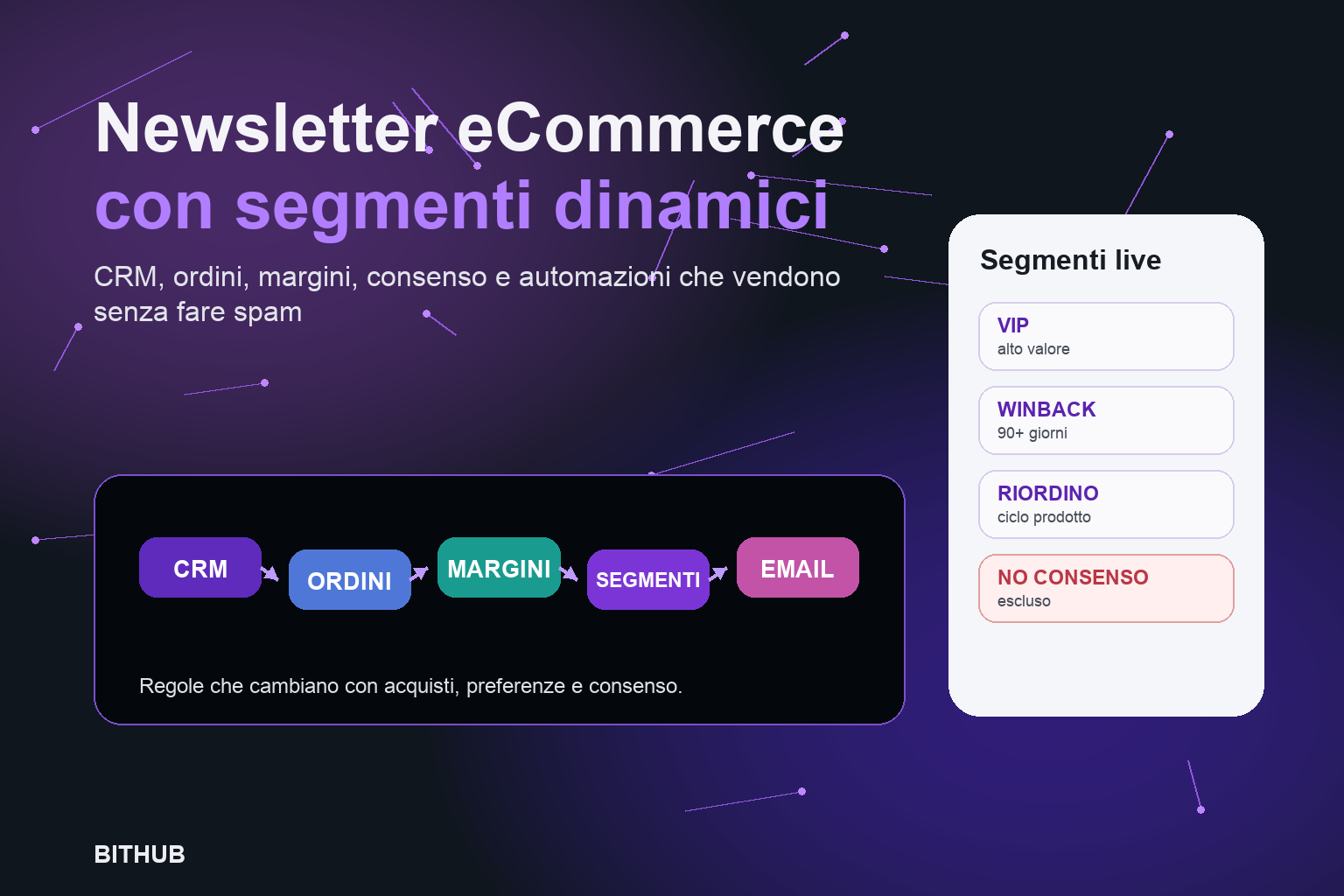
The problem with most eCommerce newsletters isn't that they sell too little. It's that they talk to everybody in exactly the same way. Same discount, same design, same urgency, same weekly send to new customers, loyal customers, dormant people, high-margin buyers and contacts who haven't opened anything for months.
At first it feels convenient: one list, one campaign, one "send" button. Then the real signals show up: open rates falling, low clicks, unsubscribes, spam complaints, coupons handed to customers who would have bought anyway, and campaigns that seem to move revenue but not margin.
A well-built eCommerce newsletter isn't a digital flyer. It's a system connected to the catalogue, the CRM, orders, consent, preferences, margins and actual customer behaviour. Segments shouldn't be static lists put together once a year: they should update themselves as purchases, interests, availability, frequency and customer value change.
Dynamic segments: what they actually are
A dynamic segment is a group of customers that updates itself based on rules and data. It isn't "VIP customer list.xlsx". It's a living condition.
Simple examples:
- customers who have bought at least twice in the last 180 days;
- people who viewed products in a category but didn't buy;
- customers who always buy the same brand;
- users subscribed to the newsletter who never became customers;
- high-value customers who haven't bought for 90 days;
- buyers of consumable products who may be due a reorder;
- customers who bought low-margin products and shouldn't be pushed with a further discount;
- people who refused marketing communications and must stay out of campaigns.
The difference is huge: you're no longer deciding by hand who receives what. You're building a system that uses real data to choose the message, the timing, the channel and the offer.
Why sending the same newsletter to everyone is a hidden cost
When you send the same email to your whole database, you're not just risking fewer sales. You're burning reputation.
Every send generates signals:
- who opens;
- who clicks;
- who ignores;
- who unsubscribes;
- who reports spam;
- who buys;
- who buys only with a discount;
- who comes back to the site but doesn't finish.
If you keep sending generic messages, you teach inboxes that your sends interest very few people. And you teach customers that your brand only communicates when it has a promo to push.
Dynamic segmentation exists precisely to avoid that waste. A customer who has just bought shouldn't immediately receive the same promo as someone who hasn't bought for six months. A customer who always buys premium products shouldn't be treated as a contact to reactivate with an aggressive coupon. A lead who never converted doesn't need the same email as a loyal customer.
What data you need to segment properly
Segmentation doesn't come from the email tool. It comes from the quality of the data you feed it.
For an eCommerce store you need at least these layers:
- profile and consent data: email, language, country, preferences, marketing permissions and opt-out history;
- order data: products bought, categories, brands, quantities, date, value, discounts, payment method and channel;
- commercial data: margin, returns, cancellations, recurrence, customer value and products to push or protect;
- behavioural data: visits, categories viewed, carts, site search, email clicks and campaign interactions;
- catalogue data: availability, seasonality, tags, filters, brands, compatible products and alternatives;
- CRM data: customer status, tickets, requests, preferences, communication history and sales notes.
If this data stays separate, the newsletter stays weak. If instead the eCommerce platform, the CRM and the marketing platform talk to each other, you can build far more relevant messages.
It's the same principle we apply when we connect CRM, ERP and digital platforms: data shouldn't live in silos. It should become a shared base for sales, support, Ads and automations.
Segments worth having for an eCommerce store
You don't need a hundred segments. You need segments that lead to better decisions.
New subscribers who aren't customers yet
They've given you their trust, but they haven't bought. What works here is orientation content, your best categories, social proof, bestsellers and clear reasons to choose the shop. You don't always need to open with a discount.
First purchase just completed
This is the moment when the brand has to confirm the choice: instructions, product care, useful content, coherent accessories, a review request at the right time and invitations to explore related categories.
Repeat customers
They shouldn't be treated like strangers. They can receive previews, bundles, smart reordering, loyalty programmes, offers on categories they already love and less aggressive messaging.
High-value customers
They're often the most expensive to lose. Here the newsletter has to avoid random promotions and work on relationship, priority, support, early access and coherent premium products.
Dormant customers
A customer who hasn't bought for 90, 180 or 365 days isn't always lost. But the message has to change: work out whether what's needed is reactivation, a new category, a reminder, a special benefit or simply cleaning the list.
Interest by category or brand
People who often visit a category, buy a certain brand or always click the same theme can receive more targeted content. This requires an orderly catalogue: categories, filters, brands and tags have to be reliable.
Consumables or predictable repurchase
If a product has an average lifespan, recurring pack sizes or consumption cycles, automation can prompt the reorder at the right moment. Not too early, and not once the customer has already bought elsewhere.
Email automations: when they help and when they annoy
Automations aren't the problem. The problem is automating the wrong messages.
A good system can handle:
- welcome flow: a proper welcome, the brand promise, main categories and social proof;
- post-purchase: usage advice, accessories, support, review requests and reordering;
- browse abandonment: recovering interest in categories or products viewed, without stalking;
- abandoned cart: a useful reminder, not just an automatic discount;
- winback: reactivating dormant customers with a message consistent with their history;
- back in stock: availability alerts on requested or viewed products;
- cross-sell: products compatible with what has been bought;
- VIP flow: relationship building with high-value customers.
But there are two classic mistakes to avoid.
The first is treating every automation as an excuse to sell immediately. The second is mixing transactional and promotional messages. An order confirmation, a password reset or a service notice shouldn't become a newsletter in disguise. The providers' own technical guidelines distinguish transactional email from promotional communications.
Consent, soft spam and bought lists
Let's be practical here: if the database isn't clean, the newsletter isn't an asset. It's a risk.
For promotional communications by email, SMS, WhatsApp or other automated channels, consent and the handling of objections have to be taken seriously. The Italian Data Protection Authority has been pointing out for years that unwanted commercial communications are spam and that promotional email sending requires specific care. There is the so-called soft spam exception for your own customers and similar products or services, but it shouldn't be turned into a free pass to send anything to anyone.
In practice:
- don't buy lists;
- don't automatically subscribe people who didn't choose to receive marketing;
- keep proof of consent and the source of the contact;
- respect unsubscribes, objections and preferences;
- if you use soft spam, stay on similar products or services and always make it easy to object;
- don't use promotional WhatsApp or SMS without a clear legal basis;
- don't put someone who unsubscribed back on the list just because they placed a new order.
The legal side isn't a brake on growth. It's part of deliverability and trust. A customer who receives unwanted messages doesn't become more loyal: they become more likely to ignore you or report you.
For all of this, it pays to connect marketing and compliance. We do the same on our page about GDPR, cookies and web compliance.
Deliverability: Gmail and Yahoo don't only look at content
The newsletter doesn't just have to look good. It has to reach the inbox.
Since 2024 Gmail has required senders to meet a set of technical and behavioural requirements, with additional requirements for anyone sending large volumes to personal Gmail addresses: SPF/DKIM authentication, DMARC for bulk senders, TLS, low spam rates, sender domain alignment and easy unsubscribe for promotional messages. Yahoo has also tightened its sender requirements and insists on authentication, complaint handling and one-click unsubscribe.
Translated into eCommerce owner language:
- the domain has to be authenticated correctly;
- SPF, DKIM and DMARC aren't details to sort out "later";
- the unsubscribe link has to be clear and working;
- people shouldn't have to fight to get off the list;
- spam complaints have to be monitored;
- sending irrelevant email degrades your domain's signal;
- segmentation helps deliverability too, because it cuts pointless sends and annoyance.
The technical side and the commercial side meet right here: if you send more relevant email to people who want to receive it, you protect both sales and reputation.
Metrics to watch: not just open rate
Open rate is increasingly fragile and isn't enough to make decisions on. An eCommerce store has to read the newsletter as a sales channel, not as a subject-line game.
The most useful metrics are:
- revenue per recipient: revenue generated per recipient reached;
- margin per send: not just gross sales;
- conversion rate by segment: which group actually responds;
- unsubscribe rate: how many people you lose with each campaign;
- spam complaint rate: a critical signal for deliverability;
- repurchase: how much the newsletter increases purchase frequency;
- coupon dependency: how many customers only buy when discounted;
- new vs returning customers: so you don't credit the wrong thing;
- effect on stock and margins: are you pushing useful products or just easy ones?
It's the same reasoning we applied to Ads: the report has to talk to orders, margins and the CRM. That holds for Google Ads, Meta Ads and the newsletter alike. We covered it in the article on Meta Ads, the pixel and the CRM and in the one on offline conversions and lead quality.
A short example: from generic send to dynamic segments
Picture an eCommerce store that sends a 10% off promo on the whole catalogue every Friday.
The report says the newsletter sells. But when you look closer you find that:
- many orders come from customers who would have bought anyway;
- high-value customers use the discount on high-margin premium products;
- dormant customers don't come back;
- new subscribers immediately get messages that are too aggressive;
- customers interested in one category receive irrelevant offers;
- unsubscribes rise precisely after the most generic sends.
With dynamic segments, the strategy changes:
- new subscribers get buying guidance and bestsellers;
- repeat customers get reordering, accessories and previews;
- dormant customers get a dedicated campaign, not the standard promo;
- VIP customers get content and benefits that lean less on discounting;
- people who showed interest in a category receive coherent products;
- anyone who unsubscribes or hasn't given consent is excluded straight away.
Revenue may not explode on the first send. But the quality of the channel improves: less waste, less annoyance, more control.
What to ask your agency before automating newsletters and CRM
Before you buy yet another email tool, ask these questions.
- What data are the segments built from?
- Do the segments update themselves, or are they static lists?
- Does the CRM receive orders, returns, margins and customer status?
- How are consent, unsubscribes and preferences handled?
- Are SPF, DKIM and DMARC configured?
- Is the marketing domain monitored for reputation?
- Do promotional sends have one-click unsubscribe where it's required?
- Do the automations distinguish transactional email from promotional email?
- Are campaigns measured on margin or only on revenue?
- Can you tell which segments are eating discount without generating value?
- Does the catalogue talk to the automations?
- Is there a rule for cleaning out inactive or unengaged contacts?
If the answer is "we send newsletters with Mailchimp/Klaviyo/Brevo and we look at opens and clicks", the most important piece is missing: the data strategy.
How we handle it at BitHub
At BitHub we treat newsletters, CRM and automations as part of the same digital ecosystem. Installing an email platform isn't enough. You need to understand where the data comes from, how it's updated and which commercial decisions it has to support.
We can work on:
- integrating the eCommerce platform, CRM, ERP and email platform;
- dynamic segments based on orders, categories, brands, margins and frequency;
- welcome, post-purchase, reorder, winback and VIP flows;
- database cleaning and preference management;
- SPF, DKIM, DMARC and sending domain configuration;
- reporting on orders, margins, returns, new and returning customers;
- connection with multichannel digital strategies and Ads campaigns;
- AI automations where they help read the catalogue, reviews, interests and content.
This connects to our work on custom eCommerce, CRM and ERP systems, AI and automations and web compliance. The newsletter works better when it isn't an isolated channel but part of the system: catalogue, data, marketing and customer.
Useful sources
For the regulatory and technical side, the useful references are the Italian Data Protection Authority's guidelines on promotional activity and countering spam, its ruling on consent for direct marketing, Google's Email sender guidelines and Yahoo's Sender Best Practices.
FAQs on eCommerce newsletters and dynamic segments
What's the difference between a list and a dynamic segment?
A list is usually static: it contains contacts added manually or imported. A dynamic segment updates itself based on rules: purchases, categories viewed, customer value, inactivity, consent, margin or behaviour.
Do eCommerce newsletters still work?
Yes, if they're relevant and connected to real customer data. They work far less well when they're generic sends to the whole database, with no segmentation, no consent management and no commercial reading of the results.
Can I send promotional email to existing customers?
In some cases the so-called soft spam exception for similar products or services can apply, but it has to be handled carefully, with a correct privacy notice and a simple way to object. It shouldn't be used to justify generic sends or unqualified lists.
Why do SPF, DKIM and DMARC matter for a newsletter?
They authenticate the domain and reduce the risk of email being rejected, landing in spam or being used for spoofing. For high-volume senders, Gmail and Yahoo require stricter configurations.
Which segments are worth creating first?
Usually: new subscribers who aren't customers yet, first purchase, repeat customers, dormant customers, high-value customers, interest by category or brand, and products with predictable reordering.
Do I necessarily need a custom platform?
Not always. But when you want to connect eCommerce, CRM, ERP, margins, consent, catalogue and automations, a well-integrated platform makes a big difference. The email tool on its own isn't enough.
Want to turn your newsletter from a generic send into a commercial system connected to CRM, catalogue and automations? We can analyse data, consent, email platform, segments and flows to build a strategy that sells without burning your domain's reputation.