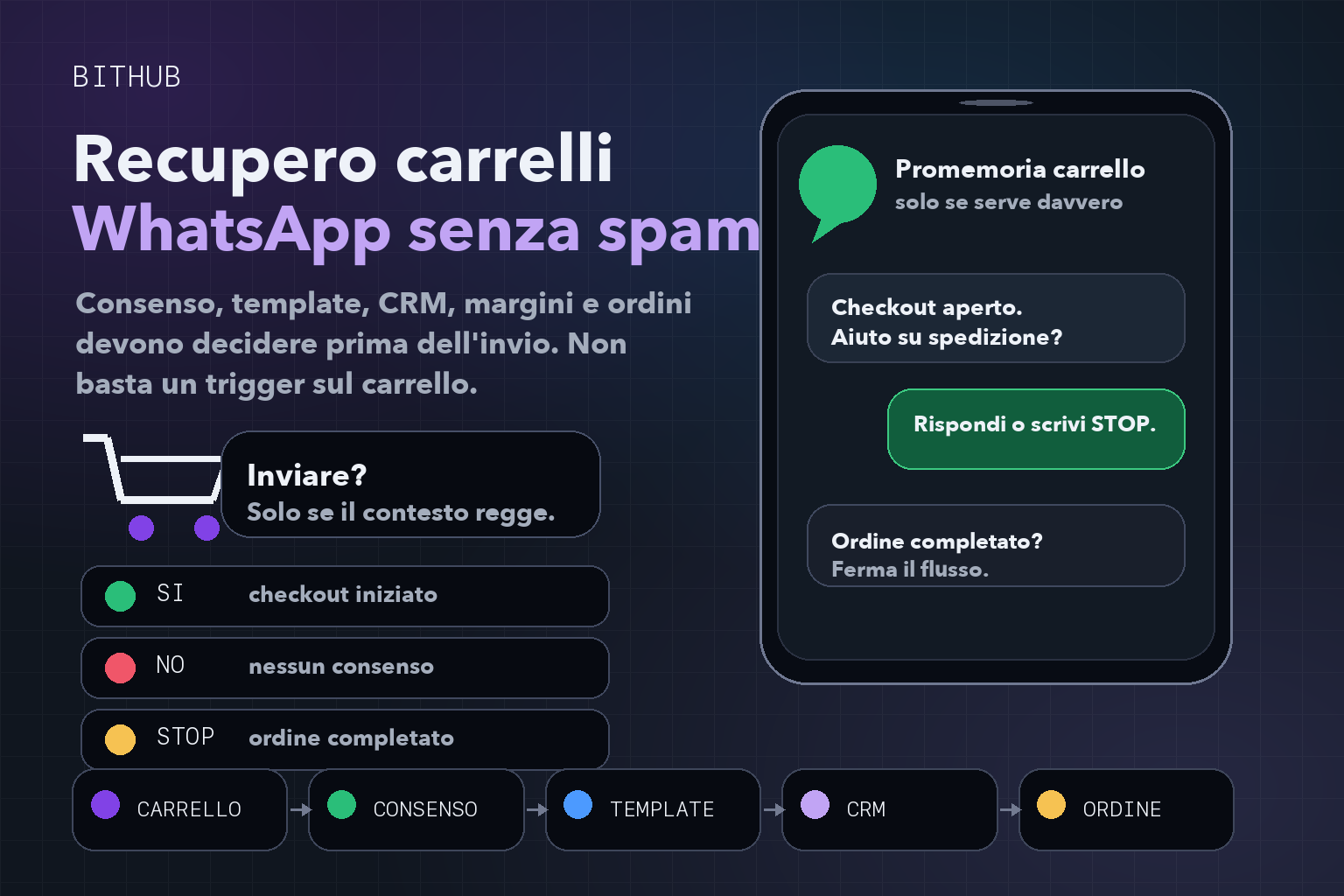
WhatsApp is not a shorter newsletter. It is a more direct, more personal and more delicate channel. Used well, it can help a customer who genuinely intended to buy. Used badly, it becomes irritating pressure in the most private corner of someone's phone.
WhatsApp cart recovery works when it is built on clean data: consent, a real cart, a started checkout, an available product, customer history, order value, margin, contact frequency and an immediate way to stop the conversation. It does not work when every add-to-cart becomes an excuse to fire off an automated message.
The difference between useful automation and spam is not the channel. It is the logic behind it.
Why WhatsApp can beat email, but only in some cases
WhatsApp has one enormous advantage: attention. People read a WhatsApp message far more readily than a promotional email. Which is exactly why the margin for error is smaller.
An ignored email usually stays just an ignored email. An unwanted WhatsApp message can feel intrusive. The customer can reply badly, block the number, write "STOP", report the message, or simply associate the brand with a feeling of pressure.
So WhatsApp should not be used because "it converts better". It should be used when you have a strong reason to enter such a personal channel.
For example:
- the customer started the checkout, not just viewed a product;
- the cart has enough commercial value;
- the product is in stock and can actually be delivered;
- the customer has given consent consistent with that kind of communication;
- the message can resolve a concrete doubt: size, compatibility, shipping, payment, quote, availability;
- the automation is connected to CRM, orders and preferences, not just to a generic site event.
Not every cart deserves a WhatsApp message
A cart is not always purchase intent. Sometimes it is a wishlist. Sometimes it is a way to check shipping and delivery times. Sometimes it is a price comparison. Sometimes it is a mistake. Sometimes it is poorly qualified traffic that arrived from a badly configured Ads campaign.
If you treat every cart the same way, you risk chasing people who were never ready to buy and disturbing the ones who would have bought later.
Before sending a WhatsApp message, it is worth filtering on at least these signals:
- funnel stage: a started checkout beats a simple add-to-cart;
- order value: not every cart worth a few pounds justifies direct contact;
- margin: recovering a low-profit order with a discount plus the cost of the message may make no sense at all;
- stock: don't push products that are out of stock, delayed or of uncertain availability;
- customer history: a returning customer should be treated differently from an unknown contact;
- consent and preferences: anyone who does not want messages has to stay out;
- recency of contact: if you already wrote yesterday, perhaps today you should not write again;
- the most appropriate channel: sometimes an email is enough, sometimes human support is needed, sometimes the right move is to do nothing.
Cart recovery should not become an automatic reaction to every add_to_cart event. It should be a commercial decision based on data.
Consent and templates: the part you cannot improvise
When a message has a promotional or commercial purpose, the basis for consent and objection has to be handled carefully. The Italian data protection authority treats promotional communications sent without respecting the rules as spam, including those sent through automated tools such as email, SMS and comparable channels. WhatsApp, given how invasive it feels, deserves even more caution.
In practice:
- do not send WhatsApp cart reminders to people who have not made a clear choice;
- do not treat numbers collected from orders, forms or support as automatically valid marketing contacts;
- keep a record of the source, date and content of the consent;
- honour opt-outs, withdrawals and preferences immediately;
- do not disguise promotional messages as service communications;
- include a simple way to stop receiving reminders, for example a "STOP" reply or updatable preferences;
- always check the specific case with whoever handles privacy and compliance in the company.
Then there is the technical side of the WhatsApp Business platform. Business-initiated messages, especially outside an active conversation window with the customer, require approved templates classified in the right category. The WhatsApp Business documentation distinguishes categories such as marketing, utility, authentication and service. Abandoned cart reminders normally fall under marketing logic, not purely transactional communication.
Which means the right question is not only "can we send the message?". It is: do we have consent, the correct template, a consent log, a send log, a block on opt-out, synchronisation with the order and a rule to stop the flow if the customer buys?
When it genuinely works
WhatsApp cart recovery makes most sense when it helps someone who was already close to buying and may have stopped for a reason you can solve.
Examples:
- checkout started, payment not completed: there may have been a technical problem, a doubt about payment or a declined card;
- complex product: size, compatibility, accessories, configuration, material or measurements may need help;
- B2B or high-value order: the customer may want confirmation on price lists, delivery, invoicing or availability;
- a customer you already know: history makes the message more useful and less generic;
- an explicit request: the customer asked to be updated on availability, a quote or reopening the cart;
- human support or well-connected AI: if the customer replies, someone or something has to be able to help for real.
In these cases the message is not "buy now". It is "do you need a hand?". That changes everything.
When it turns into spam
It becomes spam when a company uses WhatsApp to compensate for a weak strategy.
Bad signs:
- sending on every cart, however small or however recently created;
- no checks on consent and opt-out;
- aggressive sequences with several messages within a few hours;
- an automatic discount after a few minutes, training customers to abandon;
- identical messages for everyone;
- fake urgency about stock or promotions;
- no stop rule when the order is completed;
- no checks on out-of-stock products, margins or availability;
- nobody and nothing useful when the customer replies.
Cart recovery should not feel like a hand on the shoulder while the customer is still deciding. It should be help at the right moment.
Timing: when to send and when to stop
There is no universal timing. It depends on the sector, the price, the urgency, the buying cycle and the relationship with the customer. Some rules help, though.
- Don't write after five minutes: the user is often still browsing, comparing or sorting something out.
- Use less invasive channels first: email or an account notification may be enough for weak carts.
- Save WhatsApp for strong signals: checkout started, known customer, high-value order, complex product or an explicit request.
- One WhatsApp message is often enough: if the customer does not reply, insisting only makes the signal worse.
- Stop everything if they buy: it sounds obvious, but plenty of badly built automations keep writing after the order.
- Stop everything if they object: a "STOP" or a withdrawal has to update the CRM and the messaging platform immediately.
One reasonably cautious sequence might be:
- an email after 30-60 minutes, if email consent is valid;
- a second check a few hours later or the following day;
- WhatsApp only if the contact has given consent, the cart is qualified and there are no recent sends;
- if the customer replies, hand over to human support or a chatbot connected to real data;
- if they do not reply, stop or fall back gently to email, not to a barrage of messages.
The point is not to find the magic hour. It is to avoid blind automation.
Messages: good and bad examples
A bad message feels like commercial pressure. A good message feels like support.
An example to avoid
Hi! You left items in your cart. Buy now with 10% off, offer valid for a short time only!
It is generic, aggressive, and it teaches the customer that abandoning a cart earns a discount.
A more useful example
Hi [name], you left [product] in your cart. If you need help with sizing, compatibility or shipping you can reply here. If you would rather not receive these reminders, just reply STOP.
It is not perfect for every sector, but the posture changes: help, context, an easy way out.
An example for a complex product
Hi [name], we noticed you were configuring [product]. If you like, we can check compatibility, lead times and accessories together before you order. Reply here and we'll help.
Here WhatsApp makes more sense, because the cart contains a more involved decision. It is not just a reminder. It is sales support.
The data to connect before automating anything
Good WhatsApp cart recovery does not start with WhatsApp. It starts with the data.
At minimum you need:
- eCommerce: cart, checkout, products, variants, availability, price and coupons;
- orders: completed purchase, cancellation, failed payment, payment method, value and margin;
- CRM: new or returning customer, purchase history, tickets, preferences and commercial status;
- consent: authorised channel, date, source, purpose, withdrawal and opt-out;
- catalogue: categories, brands, compatibility, alternative products and related products;
- messaging: approved templates, category, language, send status, replies and blocks;
- marketing: the campaigns that generated the traffic, audiences, coupons and recent commercial pressure.
If these data sources do not talk to each other, the automation becomes dangerous. It can write to the wrong customer, at the wrong moment, about the wrong product.
A healthier automation logic
The rule must not be "abandoned cart = send WhatsApp". A more serious logic could look like this:
- detect
begin_checkoutor a qualified cart; - wait for a window that fits the sector;
- check whether the order has already been completed;
- check WhatsApp consent and the absence of an opt-out;
- check value, margin, stock and contact frequency;
- choose the most suitable approved template;
- personalise only with reliable data;
- send one message, not an aggressive sequence;
- if the customer replies, open human support or AI connected to the catalogue and orders;
- if they buy, stop everything and update the CRM;
- if they ask to stop, update consent and blocks in every system.
That is the difference between automation and bombardment.
Measuring recovery without fooling yourself
Cart recovery can look effective even when it is simply taking credit for purchases that would have happened anyway.
The metrics to watch are not just "recovered orders". You need:
- orders attributed to the flow;
- the margin on recovered orders;
- coupon usage and dependence on discounting;
- reply rate;
- opt-out or STOP rate;
- reports, blocks or complaints;
- orders that would have arrived anyway from email or direct traffic;
- incrementality, when volume allows clean tests;
- the effect on returning customers and value over time.
Watch the starting figure, too: a cart is not an order. The same mistake that ruins many Google Ads campaigns also ruins marketing automation: confusing micro-conversions with real sales. We covered it in the article on Performance Max and carts used as conversions.
What to ask your agency before switching WhatsApp on for carts
Before turning the flow on, ask these questions.
- Where does the WhatsApp consent come from and how is it documented?
- Can the customer easily withdraw consent or reply STOP?
- Is the message marketing, utility or service under WhatsApp Business logic?
- Is the template approved and consistent with the actual content?
- Does the flow stop automatically when the order is completed?
- Does the CRM receive replies, opt-outs and the send history?
- Are out-of-stock products, very low-value orders and low-margin carts excluded?
- Does recovery use data from the eCommerce platform, CRM, ERP and warehouse?
- How many messages are sent per cart?
- How is margin measured, not just revenue?
- Are there anti-nuisance rules for customers who were contacted recently?
- If the customer replies, who handles the conversation?
If the answer is "we install the plugin and it all runs", the most important part is missing.
How we handle it at BitHub
At BitHub we treat WhatsApp, email, Ads, CRM and automation as parts of the same system. We have no interest in adding another channel if the data stays disconnected.
We can work on:
- integration between eCommerce, CRM, ERP, orders and warehouse;
- multichannel marketing strategies across email, WhatsApp, SMS and customer care;
- managing consent, opt-out and logs alongside web compliance;
- cart recovery, post-purchase, reorder and customer care flows;
- AI automation connected to the catalogue, orders and the questions customers actually ask;
- reporting that reads orders, margins, returns, coupons and customer quality;
- building custom eCommerce and integrated systems when off-the-shelf tools are not enough;
- connecting CRM, ERP and digital platforms.
This article also connects to the guide on eCommerce newsletters and dynamic segments, the article on Consent Mode v2 for eCommerce and the piece on Meta Ads, the pixel and the CRM. The principle is the same: fewer isolated automations, more coherent data.
Useful sources
For more on the regulatory and technical side, useful references include the official WhatsApp Business Platform page on message costs and categories, Meta's documentation on WhatsApp templates, the Italian data protection authority's guidelines on promotional activity and spam and its decision on consent for direct marketing through automated tools.
FAQs on WhatsApp cart recovery
Can I recover abandoned carts via WhatsApp?
Yes, but not indiscriminately. You need a proper basis for the contact, managed consent, a consistent template, a simple opt-out and a flow connected to orders, CRM and preferences.
Do I need consent to send promotional WhatsApp messages?
Generally yes: if the message has a promotional or commercial purpose, consent, the privacy notice and the right to object all have to be handled carefully. The specific case should always be checked with whoever handles privacy and compliance.
Is WhatsApp cart recovery marketing or service?
As a rule an abandoned cart reminder is marketing, especially when it pushes for the purchase or contains a commercial incentive. Messages about orders already placed, payment or delivery can be a different matter, but the two should not be confused.
How many WhatsApp messages can I send for one cart?
Commercially, one is often already enough. If the customer does not reply, insisting can erode trust and increase opt-outs. Better to use frequency rules and, if anything, move to less invasive channels.
Is WhatsApp, email or SMS better for cart recovery?
It depends on consent, cart value, product type and the relationship with the customer. Email is less invasive, WhatsApp is more direct, SMS can be useful in specific cases. The channel should be chosen on context, not on whatever is fashionable.
How do I measure whether cart recovery really works?
Look at recovered orders, margin, replies, opt-outs, coupon usage, complaints and incrementality. Counting reopened carts is not enough: you need to understand whether the automation brings real sales without burning trust.
Want to know whether WhatsApp can recover carts without becoming spam? We can review consent, CRM, order data, templates, automations and reporting to build a flow that is useful, measurable and respectful of the customer.